
When I first encountered United People Global’s Sustainability Leadership Program, I was already deeply immersed in climate action. For over 10 years, I had planted thousands of seedlings and led tree-planting campaigns in schools and churches across Abuja. I was studying agroforestry, promoting sustainable farming, and running Agro-sustainability Digest, my own initiative.
But something was missing.
I had the technical knowledge and the passion, but I lacked a framework to amplify my impact beyond my immediate community. That changed when I became one of the over a thousand sustainability leaders from over 100 countries selected for UPG’s Class of 2025. What began as a nine-week training evolved into a transformation of how I understood my role as a change-maker.

The Power of Small Actions
One of the most profound shifts I experienced came from UPG’s core belief: no action is too small when done with intention. This became the guiding principle behind everything I’ve done since.
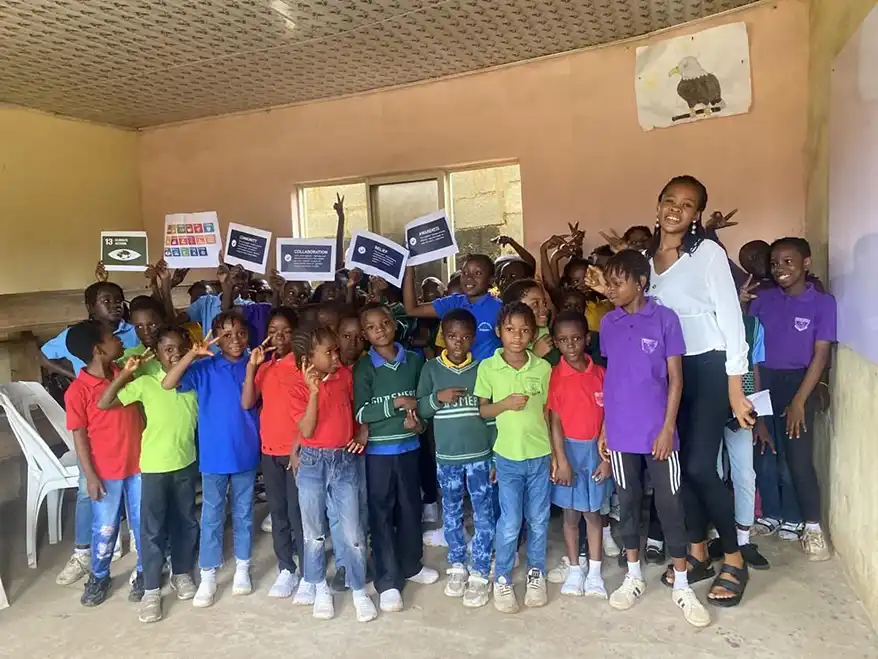
Whether leading mini-training sessions at Friendly International School or engaging professionals in sustainability discussions, I carried this message forward. One memorable moment was watching a group of teachers—our society’s front-line influencers—realize they’d never been properly introduced to sustainability or the UN’s Sustainable Development Goals (SDGs). That moment reminded me why this work matters: awareness is the first and most powerful step toward action.
Learning the Art of Possibility
UPG sustainability leadership class didn’t just train me as a leader but reshaped how I think. Through The Art of Possibility, I learned to move from limitation-based thinking to possibility-based leadership. I stopped asking “What’s wrong?” and started asking “What do we want to happen?”
This mindset revolutionized how I approached sustainability challenges. When I stood before students or teachers, I wasn’t just delivering facts—I was inviting them into a shared story of transformation.
The practice of Being the Board particularly resonated with me. When faced with systemic issues in agriculture or environment, I no longer felt powerless. Instead, I asked: “How did this get on the board that I am?” It’s a powerful shift—from reacting to taking responsibility.


From Training to Impact
The real test came when I began implementing what I had learned. I conducted 5 sustainability sessions with students and teachers, walking them through the 17 UN SDGs and UPG’s Four Pillars. I used UPG’s principles to ignite local change.
At the end of each session, I would pose two questions:
1. What are you already doing to ensure sustainability?
2. What will you begin doing after this session?
These questions called for personal responsibility—an approach that UPG modeled so well. I also discussed common environmental challenges in Nigeria and showed how even the smallest actions could be part of the solution.
The Ripple Effect
With the support of UPG and champions like Patience Ukange, we created the community of champion United People Abuja Nyanya Community, a local group driven by a shared commitment to environmental stewardship. We aim to address the significant sustainability knowledge gap—particularly among young people and smallholder farmers.
Insights from recent mini-trainings revealed widespread confusion around climate change, sustainable practices, and individual roles in climate action. In response, we launched a two-pronged initiative:
- Climate education in schools to empower the next generation.
- Climate-smart training for farmers to build resilience at the grassroots.
The school outreach was held on July 8 and 11. We also met with the local community head to discuss the second phase of our program, which will involve hands-on agroforestry training for farmers.

The Long Road Ahead
I won’t pretend this work is easy. Many educators still lack a basic understanding of sustainability. Communities often have limited resources. Progress feels slow when working at the grassroots.
But UPG taught me that sustainability isn’t about perfection—it’s about persistence. It’s about showing up, sharing knowledge, and trusting that each small spark can light a fire of change.

Telling the “We” Story
Perhaps the most powerful lesson I’ve learned is this: sustainability isn’t a me story—it’s a we story. It’s about collective transformation. When I talk about climate change today, I’m not just sharing what I know. I’m inviting others into a shared vision of what’s possible.
This shift from individualism to collaboration has changed everything. I no longer ask, “How can I fix this?” but “How can we solve this together?” It turns conflict into cooperation and limitations into innovation.
I particularly thank ‘Member Tribe 9, called the wave of change – a group that was supportive in ensuring we complete our activities needed as a team for the training.
A special shout out to Nouran Farouk who is doing a great work in Egypt, empowering women with clean mobility skills through her organization ‘Dosy‘, a tech-based scooter and bicycle riding platform for Egyptian women, and promoting inclusivity.
And a huge shout out to my community of champions, the United people Abuja Nyanya community, for ensuring we were able to carry out two projects, along with Patience Ukange, the founder of ‘The Confidence Woman,’ an NGO empowering women and girls in the IDPs in Nigeria.

Continuing the Work
As I continue working in agroforestry, climate action, and sustainability education, I carry everything UPG has taught me. My academic foundation—a Master’s in Agroforestry and Food Security—provides the knowledge. But UPG gave me the tools to translate that knowledge into real-world change.
Today, I’m part of a global network of leaders dedicated to making a difference. Over 100,000 people applied to join UPG’s Class of 2025. Since 2019, UPG Sustainability Leaders have directly trained more than 86,000 people around the world on the SDGs and sustainable action.
We’re not just planting trees. We’re planting hope.
We’re not just educating minds. We’re nurturing leaders.
And we’re not just solving problems. We’re creating new possibilities—together.

Deborah Elesie is a sustainability leader, agroforestry researcher, and founder of Agro-sustainability Digest. She is passionate about helping farmers adapt to climate change through natural, resilient farming practices. Through her work in education, climate action, and environmental restoration, she is committed to building a more sustainable world—one small, intentional action at a time. She is currently a technical support officer at Savannah Climate Action Initiative ( SAVCLIM-AFRICA), where she supports program implementation in tree planting, land restoration, agroforestry, and environmental education across dryland regions in Nigeria. You can reach her at: deborahelesie@gmail.com
Watch the story here