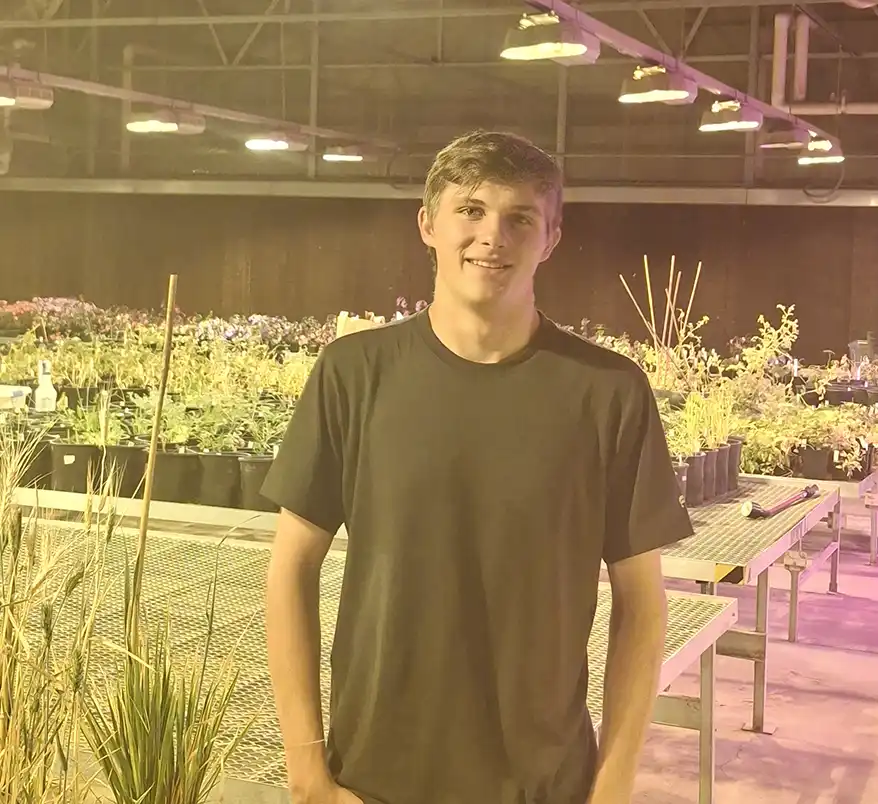
I spent most of my childhood in a suburb of Denver, where I raised goats and chickens, helped my scientist father and schoolteacher mother tend to an extensive vegetable garden, and watched Smithsonian documentaries in the living room.
These habits instilled an aptitude for learning and spending time outside that I continue to integrate into my life as a student at Colorado State University. All of these different seeds of my childhood have germinated and begun sprouting into the student and aspiring scientist that I am becoming.

Currently, I am studying Biomedical Sciences with a concentration in Microbiology, Immunology, and Pathology. I am also studying Spanish Language and Chemistry as minor studies.
I decided in my first semester that I wanted to work in a lab. I wanted experience, and I wanted to get an idea of different types of careers I could choose in the future.
I searched tirelessly on various websites for different lab volunteering opportunities and paid positions. After several months of searching, I was hired by Dr. Meenakshi Santra in the biggest wheat double-haploid lab in the country, where Dr. Santra is refining her fine-tuned and ground-breaking protocol to produce double-haploid wheat.
This is a process in which the offspring of a particular crop is made to be genetically similar to the parent plant by using only the genome of one parent to develop a seed.
Introduction to Biopesticides
This job isn’t exactly catering directly to anything I am studying, so when Dr. Santra gave me the idea of starting my own project outside of work hours, I was ecstatic.
In my academic journey thus far, I have taken an array of classes in which I have learned a lot about pathogens and disease. I took a class specializing in parasites, and a class focusing on bacterial infection and the chemical and molecular mechanisms that bacteria use to resist treatment as they evolve against the antibiotic drugs that we are using.
So, to get my wheat disease project started, I simply made a quick internet search and found the most notorious and prevalent disease that attacks the crops of the West.
Wheat rust, or Puccinia triticina, is a fungus that spreads by releasing long-lasting spores into the wind and soil, and these spores then grow into full mycelium, or adult fungi, on the leaves of wheat. The fungus then drains the nutrients, sugars, and water directly from the leaves, depriving the crop of nutrients1.
In my classes, I studied a lot of different bacteria, many of which I cultured myself for various experiments and projects, and I learned about how these bacteria can produce toxic compounds that kill each other, amongst other life forms. In fact, many of the antibiotic compounds we use as medicine were derived from bacteria.
I decided to do some more thorough research on the bacteria that I did a final project on: Bacillus subtilis. This bacteria produces a multitude of these compounds that are quite effective in attacking bacterial and fungal pathogens. Additionally, B. subtilis is also deadly against a variety of pests including fungi, bacteria, and animals like insects5.
One study in the Egyptian Journal of Biological Pest Control4 finds that B. subtilis bacteria is indeed effective in controlling and inhibiting the growth of P. triticina(wheat rust). This of course, was on a petri dish, so I am going to see how B. subtilis can be used in practice.

A Small, Relevant Experiment
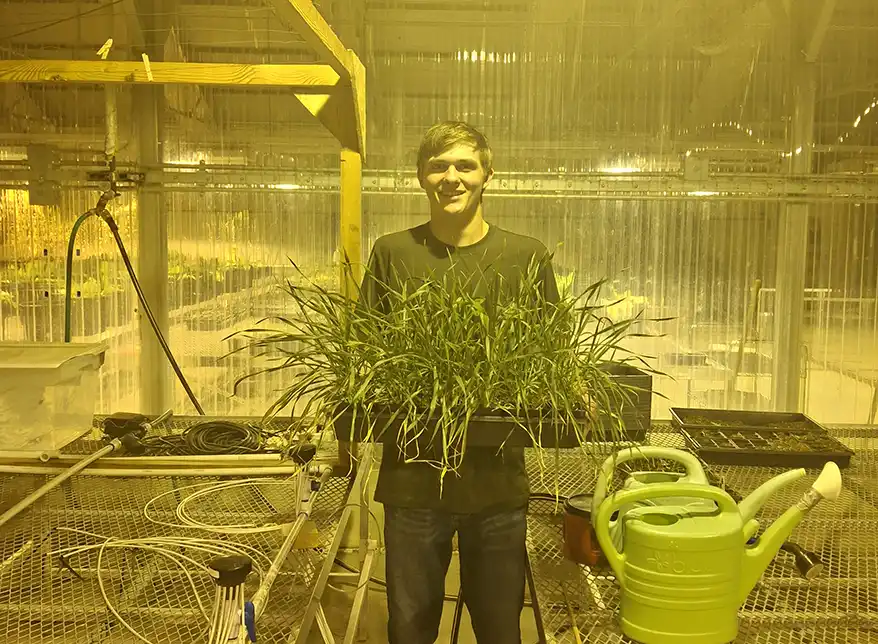
In order to do this, I am currently growing three different wheat varieties which I will infect with wheat rust spores. After allowing the disease to spread, I will subject one group of wheat to direct application of B. subtilisbacteria on the leaves in an attempt to kill the fungal spores, and in another group I will add the bacteria to the soil.
The bacteria has been found to be quite beneficial to plants2, producing helpful proteins and compounds that help the plant to recover faster from damage, grow more easily. B. subtilis has even been found to maintain a healthier micro-ecosystem, maintaining healthy populations of other helpful bacteria such as nitrogen fixers and rhizobacteria which aid in water and nutrient access at the roots.
Thus, I will see how the bacteria helps plants fight the infection, as well as how the bacteria fights the infection directly, all without compromising the health of my plants, because B. subtilis is a natural partner of plants in the soil2.
The Sustainability Factor
Additionally, the sustainability behind using a bacterial agent rather than a typical pesticide has the potential to be revolutionary7. There are countless studies and large science-backed organizations that accept the advantages of “biopesticides” as fact.
One study6 published in F1000 Research and in the National Library of Medicine outlines the advantages of living pesticides, stating that not only are these treatments biodegradable and non-impactful to the soil, but that they also have “low to no toxicity to humans and the environment”(6).
Further, the study states that microbial biopesticides are “cost-competitive with other pesticides”(6) and also asserts that biopesticides would contribute less to the growing resistance to pesticides that harmful bacteria and pathogens are developing.
Biopesticide bacteria are very specific in the organisms that they harm, and many soil-dwelling bacteria are also know to have symbiotic relationships with one another, ensuring that a healthy ecosystem can still thrive with a variety of bacteria species even with the application of bacteria as pesticides.
Role of Rhizospheric Microbes in Soil3 published by Springer Nature outlines the benefits of adding bacteria to the soil in which crops are grown. Chapter 14 of this journal outlines the various benefits of biopesticides and biofertilizers. Bacteria have been found to break down a wide range of nutrients, other than nitrogen, such as phosphate, which is an important ingredient in any fertilizer. Many species of soil-dwelling bacteria can help reduce harmful insects, fungi, and bacteria. Furthermore, in the concluding remarks of Chapter 14, it is stated that typical chemical fertilizers and pesticides have a tendency to “[Cause] adverse effect on human health, groundwater quality, and soil fertility.” Whereas biopesticides are less impactful and don’t share the same effects.
A professional yet personal quest
I hope that I can see some positive results with my experiment and get some valuable feedback from the professors and evaluators when I present my project.
I hope that I can demonstrate and examine the potential of biopesticide tools for myself, as well as gain more experience with my scientific writing and presenting.
I hope to take the skills I am developing now and apply them to countless future endeavors.
But mostly, I hope that we as a society apply ourselves more to exploring potential tools such as this as a means to mitigate the emerging challenges that are threatening our future.
I hope to one day join and contribute to the collaborative effort that we will have to make in order to fix what we have destroyed in the soil we use, the atmosphere we live in, and the organisms we are surrounded by.
References
- Annan, E. N., & Huang, L. (2023). Molecular Mechanisms of the Co-Evolution of Wheat and Rust Pathogens. Plants. 12(9), Page 1809. (https://doi.org/10.3390/plants12091809)
- Hashem, A., Tabassum, B., & Fathi Abd Allah, E. (2019). Bacillus subtilis: A plant-growth-promoting rhizobacterium that also impacts biotic stress. Saudi journal of biological sciences. 26(6), Pages 1291–1297. (https://doi.org/10.1016/j.sjbs.2019.05.004)
- Kumar, V.V. (2018). Biofertilizers and Biopesticides in Sustainable Agriculture. Role of Rhizospheric Microbes in Soil. Springer. (https://doi.org/10.1007/978-981-10-8402-7_14)
- Omara, R.I., Essa, T.A., Khalil, A.A. et al (2020).A case study of non-traditional treatments for the control of wheat stem rust disease. Egypt Journal of Biological Pest Control. (https://doi.org/10.1186/s41938-020-00284-3)
- Ramachandran, R., Chalasani, A. G., Lal, R., & Roy, U. (2014). A broad-spectrum antimicrobial activity of Bacillus subtilis RLID. The Scientific World Journal. 12(1). (https://doi.org/10.1155/2014/968487)
- Tadesse Mawcha K, Malinga L, Muir D et al (2025). Recent Advances in Biopesticide Research and Development with a Focus on Microbials. F1000Research. 13(1071). (https://doi.org/10.12688/f1000research.154392.5)
- Tao Wang, Yafei Liang, Mianbin Wu, Zhengjie Chen, Jianping Lin, Lirong Yang (2015). Natural products from Bacillus subtilis with antimicrobial properties. Chinese Journal of Chemical Engineering. 23(4), Pages 744-754. (https://doi.org/10.1016/j.cjche.2014.05.020)

Colten Blake is a student of Colorado State University