
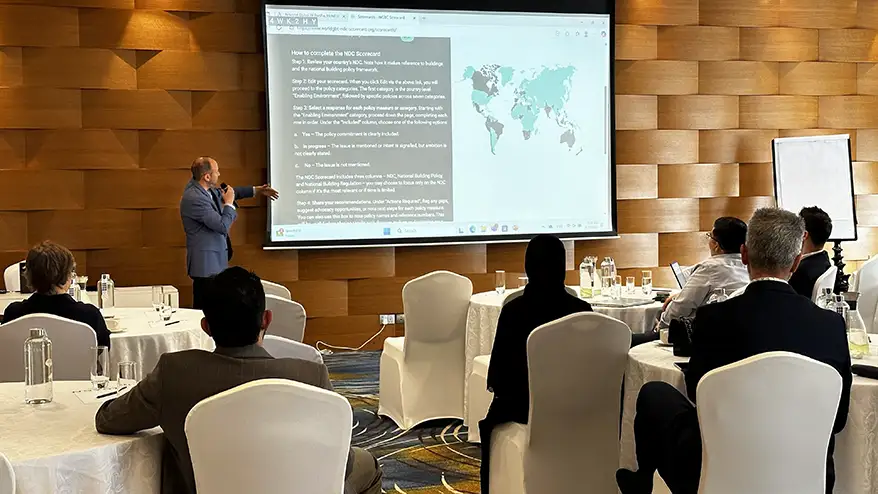
Dubai, UAE; November 10, 2025: The Emirates Green Building Council (EmiratesGBC), a non-profit organisation dedicated to advancing green building principles in the UAE, has released its ‘NDC Scorecard Action Plan Report, outlining critical next steps for integrating the built environment into the UAE’s Nationally Determined Contributions (NDC).
This comprehensive report builds upon the findings of the World Green Building Council’s NDC Scorecard for Sustainable Buildings and includes insights from experts gathered at a multi-stakeholder workshop on August 19, 2025, which convened key government entities, industry leaders, and academic experts to identify current NDC alignment and chart the UAE’s priority next steps towards a sustainable future. The UAE’s third NDC (NDC 3.0) under the Paris Agreement represents a crucial step in the nation’s ongoing commitment to global climate action.
EmiratesGBC’s new report reveals a maturing sustainability agenda in the UAE, moving beyond traditional energy efficiency to a multi-dimensional framework that increasingly prioritises circularity and climate resilience, suggesting a pivot from “how buildings consume resources” to “how systems withstand shocks and regenerate value.” The buildings sector stands as a cornerstone of the UAE’s climate action, targeted to achieve an ambitious 79% reduction in emissions by 2035, contributing significantly to the nation’s overall 47% GHG reduction goal.

Khaled Bushnaq, EmiratesGBC Chairman, said: “This report reinforces the important role buildings in the UAE can play in achieving our ambitious NDC targets. As the UAE continues its rapid urban development, the nation’s holistic strategy will solidify its leadership in green development and drive tangible progress towards a greener, more resilient built environment, benefiting both people and planet.”
The report reveals that Carbon & Energy are at the forefront of the UAE’s priorities, reflecting the nation’s strategic focus on decarbonising the built environment and enhancing energy efficiency. Circularity is ranked second, emphasising the importance of resource optimisation and waste reduction in construction practices. Water—a critical resource in the UAE’s arid climate—follows closely, underscoring the need for innovative water conservation and reuse strategies.
The inclusion of Adaptation & Resilience highlights the urgency of preparing infrastructure for climate-related risks, while Health & Wellbeing signals a growing emphasis on occupant comfort and indoor environmental quality. Though currently underweighted in stakeholder focus, Biodiversity & Nature and Equity & Access require renewed attention as they are critical to long-term resilience and are essential for ensuring ecological integrity and inclusive urban development.
Strengthening the role of buildings in the UAE’s NDC should be a national priority due to the sector’s outsized impact and strategic importance. Buildings serve as a nexus between multiple sectors—such as energy, water, waste, and transport—offering a unique opportunity for integrated and cross-cutting solutions. The report calls for mandating circularity measures in construction, including upcycling, building reuse, and durability standards, alongside climate risk assessments for buildings and the integration of future climate scenarios into urban planning.
Key priority actions include boosting energy efficiency through new rating systems, promoting renewables, and introducing green financing. The report also emphasises advancing whole life carbon management by mandating comprehensive GHG emissions monitoring aligned with 2035 targets. To strengthen resilience, EmiratesGBC calls for integrating robust requirements into building codes and climate risk assessments. Finally, protecting health and nature is prioritised through indoor air quality standards, low-emission zones, and integrating biodiversity considerations into financing and operational practices.
The EmiratesGBC report issues a clear call to action for all stakeholders. Government entities are urged to harmonise regulations, update the NDC to include missing policy categories, and develop new policies for energy ratings, water reuse, indoor air quality, and resilience. The report urges industry leaders to integrate resilience and circularity into designs and operations, adopt best sustainable practices, and inform regulators of market advancements. The finance sector is encouraged to develop innovative green financing mechanisms and update insurance systems to accurately reflect climate risks.