
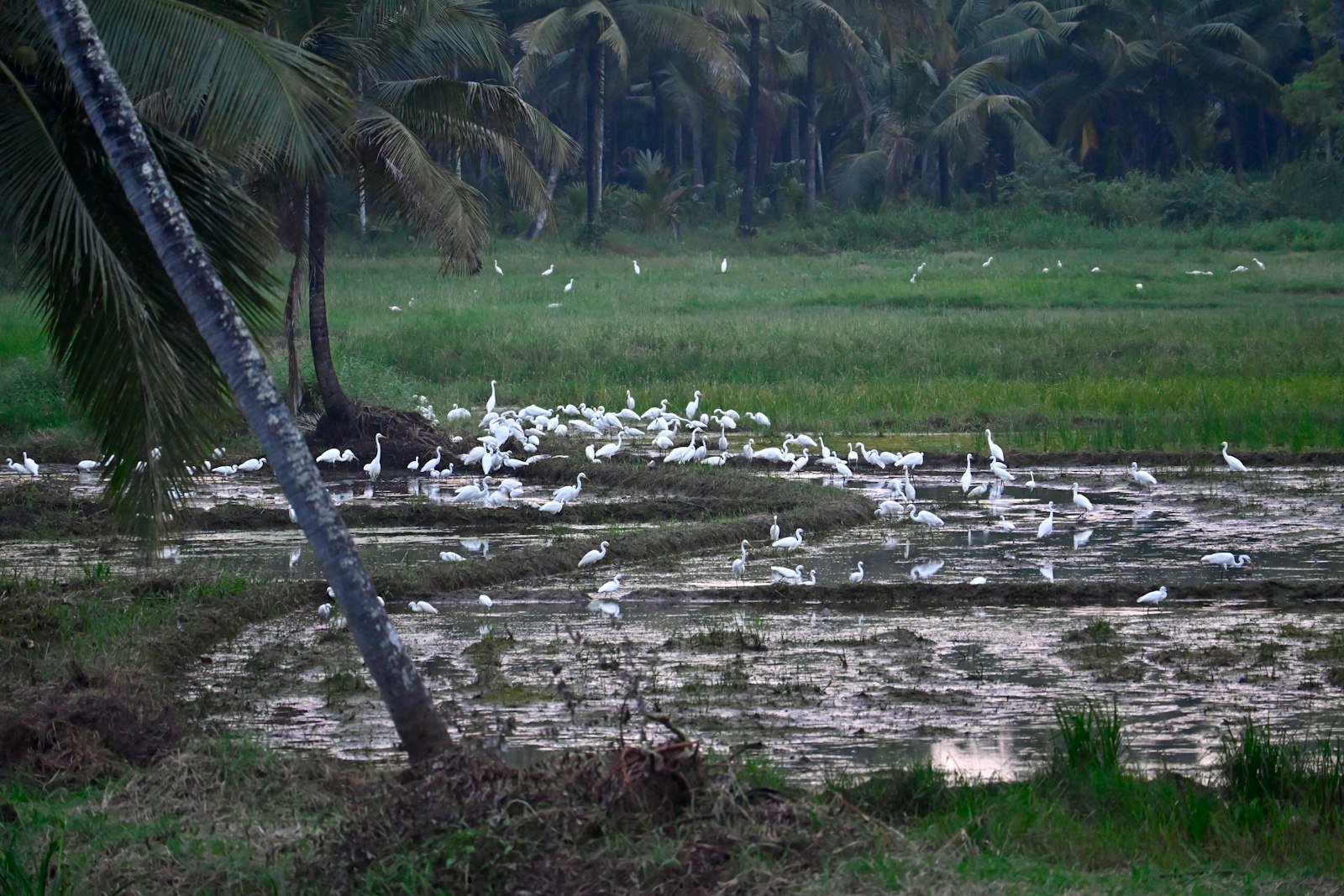
Paddy cultivation in Kerala covered 1.76 lakh hectares in 2024-25, the Kerala State Planning Board’s Economic Review 2025 shows. That is about one-fifth of the 8.75 lakh hectares farmed in 1970-71. The state grew 5.30 lakh tonnes of rice that year, against an estimated demand of 38 to 40 lakh tonnes.
Kerala closes that gap with rice grown in Andhra Pradesh, Tamil Nadu and Karnataka, as The Fourth Plate reported when the state turned 70 on 1 November. This guide sets out the decline decade by decade, the districts that lost most, why farmers left and what the 2008 paddy land law has done. It also covers the ecological cost and the revival schemes now running.
Key facts
- Paddy area was 1.76 lakh ha in 2024-25, down from 8.75 lakh ha in 1970-71 (Kerala State Planning Board, Economic Review 2025)
- Rice output was 5.30 lakh tonnes in 2024-25, against 12.98 lakh tonnes in 1970-71 (Economic Review 2025)
- Yield reached 3,006 kg per hectare in 2024-25, double the 1,483 kg of 1970-71 (Economic Review 2025; M P Abraham, 2019)
- Kerala’s own fields meet about 13 to 14% of its rice demand (Fourth Plate calculation from Economic Review 2025 and Krishi Jagran, 2022)
- The state cleared 10,950 ha of paddy land for other uses between 2018-19 and 2024-25 and collected Rs 1,606.9 crore in fees (Onmanorama, from Assembly figures, 2025)
- Supplyco buys paddy at the Centre’s minimum support price plus a state incentive; the 2026-27 MSP for common paddy is Rs 2,441 a quintal (Rs 24.41 a kg), and Kerala raised its support by Rs 300 a quintal in August 2026 (Union Cabinet, via Devdiscourse and S&P Global, May 2026; Congress Bharath, August 2026)
- Palakkad, Alappuzha, Thrissur and Kottayam held 81.53% of rice area in 2024-25 (Economic Review 2025)

How much paddy land Kerala has lost since 1970
Kerala farmed 8.75 lakh hectares of paddy in 1970-71 and 1.76 lakh hectares in 2024-25, a fall of 79.8%. Rice output fell 59% over the same period, from 12.98 lakh tonnes to 5.30 lakh tonnes.
The Fourth Plate compiled the table below from the Quick Look tables of the Economic Review 2025. We checked each decade against M P Abraham’s 2019 trend analysis of Kerala Economic Review data, published by the Government College, Attingal. The two series match on area.
| Year | Paddy area (000 ha) | Change on previous row | Rice output (000 tonnes) | Yield (kg/ha) | Output per resident (kg) |
|---|---|---|---|---|---|
| 1960-61 | 779 | 1,068 | 1,371 | 63.2 | |
| 1970-71 | 875 | +12.3% | 1,298 | 1,483 | 60.8 |
| 1980-81 | 802 | -8.3% | 1,272 | 1,586 | 50.0 |
| 1990-91 | 559 | -30.3% | 1,087 | 1,945 | 37.4 |
| 2000-01 | 347 | -37.9% | 751 | 2,164 | 23.6 |
| 2010-11 | 213.2 | -38.6% | 522.7 | 2,452 | 15.6 |
| 2020-21 | 201.87 | -5.3% | 626.9 | 3,105 | n/a |
| 2024-25 | 176.36 | -12.6% | 530.22 | 3,006 | n/a |
The steepest falls came in the 1990s and 2000s, when Kerala lost more than a third of its paddy area in each decade. Abraham’s series puts the peak at 8.76 lakh hectares in 1975-76.
Better yields slowed the loss of grain. A hectare of Kerala paddy produced 1,483 kg in 1970-71 and 3,006 kg in 2024-25. Output therefore fell less steeply than area. The pandemic year 2020-21 brought a short revival to 2.02 lakh hectares and 6.27 lakh tonnes, the decade’s high.
Rice grown per Keralite has fallen by three-quarters
The last column of the table is a Fourth Plate calculation. It divides each decade’s rice output by Kerala’s census population. In 1970-71 the state grew 12.98 lakh tonnes for 2.13 crore people, or 60.8 kg a person. In 2010-11 it grew 5.23 lakh tonnes for 3.34 crore people, or 15.6 kg a person. The 2011 census remains the latest, so we leave later rows blank. Kerala’s population has grown since 2011, so the current figure sits below 15.9 kg.
Where Kerala’s paddy fields have disappeared fastest
Paddy cultivation in Kerala has retreated to a few districts, and the midland and northern districts lost most of their fields. Between 1980-81 and 2011-12, Ernakulam, Malappuram and Thiruvananthapuram each lost more than 90% of their paddy area, while Kottayam lost a third.
| District | Paddy area 1980-81 (ha) | Paddy area 2011-12 (ha) | Loss | Rice output 2024-25 (tonnes) |
|---|---|---|---|---|
| Palakkad | 183,634 | 83,998 | 54% | 215,141 |
| Thrissur | 110,314 | 21,172 | 81% | 74,347 |
| Ernakulam | 102,500 | 7,731 | 92% | 8,310 |
| Alappuzha* | 82,466 | 36,251 | n/c | 102,332 |
| Malappuram | 80,022 | 7,528 | 91% | 29,506 |
| Kannur* | 73,465 | 5,740 | n/c | 7,793 |
| Kollam* | 50,055 | 2,097 | n/c | 3,123 |
| Kozhikode* | 45,451 | 2,920 | n/c | 1,889 |
| Thiruvananthapuram | 32,583 | 2,395 | 93% | 3,334 |
| Kottayam | 31,948 | 21,410 | 33% | 49,024 |
| Wayanad | n/a | 8,995 | n/a | 21,819 |
The pattern follows the land market. Districts with fast-growing towns and Gulf money, such as Ernakulam and Malappuram, kept less than a tenth of their 1980 paddy area. Palakkad, the largest rice bowl, kept 46%.
Palakkad
Palakkad grew 215,141 tonnes of rice in 2024-25, or 40.6% of Kerala’s output, the Economic Review 2025 shows. Its yield of 3,281 kg per hectare was the state’s highest, and it produced 69.92% of the autumn Virippu crop. Climate is the next threat; a model of the Bharathapuzha basin projects Palakkad paddy yields falling 54% to 74% by 2100.
Kuttanad
Kuttanad spans 874 square kilometres across Alappuzha, Kottayam and Pathanamthitta, the State Planning Board’s 2019 Special Package for Post-Flood Kuttanad says. About 490 square kilometres lie 1 to 2 metres below mean sea level and are farmed for rice. The FAO lists Kuttanad as a Globally Important Agricultural Heritage System. Alappuzha grew 102,332 tonnes of rice in 2024-25, much of it in the summer Puncha season.
The Kole wetlands of Thrissur and Malappuram
The Kole lands cover about 13,632 hectares in Thrissur and Malappuram, Scroll.in reported in 2017. A Kerala Agricultural University study places them 0.5 to 1 metre below sea level. Farmers grow rice from December to May, and the fields stay under water from June to November. Thrissur lost 81% of its paddy area between 1980-81 and 2011-12 and recorded the most conversions approved after 2018.
Wayanad
Wayanad farmed 8,995 hectares of paddy in 2011-12 and grew 21,819 tonnes of rice in 2024-25. Its paddy depends on the Kabini and its tributaries; in October 2026, farmers in Pulpally said the monsoon had failed so badly that transplanting stalled. The district lost Cheruvayal Raman, who conserved more than 45 traditional rice varieties, in October 2026.
Onattukara
Onattukara, the sandy coastal tract of southern Alappuzha and northern Kollam, appears as a special rice zone in the state’s Rice Development scheme. At Thazhava near Karunagappally, about 1,000 acres of padasekharam had lain fallow for more than ten years before a 2018 revival drive, Deccan Chronicle reported.
What replaced the fields
Coconut and rubber took most of the converted land, Abraham’s study finds. Coconut spread over former paddy in Thiruvananthapuram, Kollam, Thrissur, Palakkad and the northern districts; rubber replaced it in Kottayam, Idukki and Ernakulam. Thomas shows rice falling from 32.1% of Kerala’s gross cropped area in 1965-66 to 12.01% in 2003-04. Over the same years coconut rose from 22.5% to 35.1% and rubber from 5.9% to 18.4%. Rice covered 7.01% of cropped area in 2024-25. Houses, roads and shops took the rest, along with fields left fallow.
Why paddy cultivation in Kerala declined
Kerala’s farmers left paddy because the same land earned far more under other crops or as building plots. Scarce, costly labour and late payment for paddy widened that gap.
Labour costs and shortages
A male paddy field worker in Kerala earned Rs 858.79 a day in 2024-25 (about $9.05), and a woman Rs 709.10, the Economic Review 2025 reports. Labour makes up 40 to 50% of rice production costs, Teena Antony wrote in a 2024 JANAL Digital Archives study. Thomas found that Kerala’s farm workforce fell by 8.79 lakh between 1993-94 and 2004-05, while total employment grew by 16.05 lakh. Migrant workers from West Bengal now plant and harvest many of the fields that remain, The Fourth Plate has reported.
Low returns from rice
Paddy earns little per acre compared with other crops. In Thomas’s 2004 field data from Palakkad, an acre of rice returned Rs 2,400 in net income and an acre of banana Rs 46,000. A Palakkad farmer told him he spent Rs 17,000 to Rs 18,000 an acre each season and kept about Rs 10,000, before counting family labour.
Procurement prices and payment delays
Supplyco, the Kerala State Civil Supplies Corporation, is the state’s main paddy buyer. It pays the Centre’s minimum support price (MSP) plus a state incentive. The Union Cabinet set the MSP for common paddy for the 2026-27 kharif marketing season at Rs 2,441 a quintal (Rs 24.41 a kg) in May 2026, up Rs 72, Devdiscourse and S&P Global reported. Kerala raised its procurement support for paddy by Rs 300 a quintal in August 2026, Congress Bharath reported.
Open-market mandi rates for common paddy in Kerala ranged from Rs 2,500 a quintal in Kasaragod to Rs 3,130 a quintal (Rs 31.30 a kg) in Pulpally, Wayanad, in November 2026, the mandi price trackers Commodity Online and KisanDeals show. Supplyco bought 5.79 lakh tonnes of paddy across the two crops of 2024-25, from 57,529 farmers for the first and 1.5 lakh for the second, Civil Supplies Minister G R Anil said in August 2025, The News Minute reported. By then it had paid Rs 873 crore of the Rs 1,232 crore owed for the second crop. Anil said the Centre had withheld Rs 1,259 crore due since 2017-18.
Payments reach farmers through Paddy Receipt Sheet (PRS) loans from banks, which wait on central reimbursement. The South First reported that Supplyco usually waits six to eight months for that money. In January 2026 the state said it would hand procurement to cooperative societies. Procurement societies now operate in Kottayam and Palakkad.
Gulf money and land as an asset
Teena Antony links the Gulf boom to rising land prices that turned paddy fields into speculative assets. The Kerala Migration Survey 2023 counted 2.2 million emigrants and Rs 2.16 lakh crore (about $22.8bn) in remittances. Thomas describes paddy land being bought for housing and commercial plots from the 1980s, driven by remittance income and population density. In Kannadi village in Palakkad, he recorded one-hundredth of an acre selling for Rs 2 lakh.
Fragmented holdings
Land reform gave tenants ownership and split large holdings into small plots. Teena Antony notes that agricultural labourers received house plots of 4 to 10 cents. The Kerala Land Reforms Act still bans agricultural leasing, which researchers at the Centre for Public Policy Research link to fallow fields, as The Fourth Plate has reported. Antony also found that a paddy holding of one to five acres cannot keep a family at a middle-class standard of living.
What the Kerala Conservation of Paddy Land and Wetland Act says
The Kerala Conservation of Paddy Land and Wetland Act, 2008 bars any owner or occupier from converting paddy land except as the Act allows. It came into force on 12 August 2008. The Act defines paddy land as land where paddy is grown at least once a year, or land suitable for paddy but left fallow.
The data bank
Each panchayat or municipality has a Local Level Monitoring Committee, with the local Agricultural Officer as convener and three farmer representatives. The committee prepares a data bank of paddy land and wetland from satellite-based maps, and the local body notifies it. Land in the data bank is notified land. In June 2018 the Kerala Sastra Sahitya Parishad said the government was amending the law without an authentic data bank.
The 2018 amendment
The 2018 amendment created a category of unnotified land: land recorded as paddy in the Basic Tax Register but left out of the notified data bank. It added Sections 27A to 27D, which let a Revenue Divisional Officer approve a change of use on payment of a fee. The Supreme Court held in May 2025 that the amendment, deemed in force from 30 December 2017, cannot apply to earlier applications.
The amendment also eased conversion of notified land for public purposes. The Kerala High Court held in 2023 that a project no longer needs to show that no alternative land is available. Critics argued at the time that the government could call any project public; Usha S of the Thiruvananthapuram NGO Thanal raised that concern, The News Minute reported.
Conversion fees
Unnotified land up to 25 cents converts without a fee. Above 25 cents, the owner pays 10% of fair value on the whole plot. The Supreme Court settled that in State of Kerala v Moushmi Ann Jacob in February 2025. A plot of 30 cents therefore pays on all 30 cents. Owners of land above 20.23 ares must also set aside 10% for water conservation, Lawwatch explains.
How the law has worked
The state approved the conversion of 10,950 hectares of paddy land between 2018-19 and 2024-25, Onmanorama reported from Assembly figures. It collected Rs 1,606.9 crore (about $169m) in fees. Thrissur recorded the most, at 2,150.58 hectares, followed by Ernakulam at 1,649.86 hectares. By February 2025, the Revenue Department had received 5.62 lakh applications and cleared 2.9 lakh.
The law requires conversion fees to fund the restoration of paddy land. The Kerala High Court ordered the state to move Rs 1,510 crore into that fund, as The Fourth Plate reported in The Rs 1,510-Crore Question. Our Farms or Malls investigation traced how the law was tested at a contested site in Thrissur. The figures show the Act has slowed conversion and put a price on it, while thousands of hectares still change use.
Why paddy fields matter for floods, groundwater and wildlife
Kerala’s paddy fields store floodwater, recharge wells and feed wetland birds and fish. Each hectare filled for a house or road removes that storage from the river basin.
Flood storage and the 2018 floods
Four rivers poured about 1.63 billion cubic metres into Kuttanad from 15 to 17 August 2018, the State Planning Board found. Vembanad Lake can carry 0.6 billion cubic metres. The flood destroyed paddy on about 15,000 hectares. Kuttanad’s fields cover an area equal to 35 of Kerala’s major reservoirs, K G Padma Kumar said in a 2020 interview. He directs the International Research and Training Centre for Below Sea-level Farming. He urged the state to hold water in at least 70% of them during heavy rain.
Hans Nicolai Adam of the Institute of Development Studies, Sussex, wrote in 2018 that conversion had weakened Kerala’s wetlands as floodplains. He cited Raj and Azeez (2009), who estimated that 63 to 76% of Kuttanad’s wetlands had been filled or diverted to other uses since 1995.
Groundwater recharge
One hectare of paddy land recharges nearly 2 crore litres of groundwater over three seasons. M Manjula and P Indira Devi cited that estimate in The News Minute in 2020. Paddy fields hold standing water for months, and that water seeps into the wells many Kerala households still use.
Wetland birds and fish
The Thrissur-Ponnani Kole wetlands rank among India’s richest waterbird sites, with 241 species recorded. The Asian Waterbird Census counted 33,499 birds there in 2018 and 9,904 in 2023, a fall of 70%, according to census reports and GKToday. The next census counted 13,697 birds of 106 species. Kerala Agricultural University’s P O Nameer, who led it, said field activity during the count may have played a part.
How much rice Kerala grows and how much it buys from other states
Kerala grows about one-seventh of the rice it eats. The rest arrives by rail and road, mainly from Andhra Pradesh, Tamil Nadu and Karnataka.
Kerala’s rice self-sufficiency ratio
Kerala’s annual rice demand is an estimated 38 to 40 lakh tonnes, Krishi Jagran reported in November 2022. The Fourth Plate’s calculation for 2024-25 divides the state’s 5.30 lakh tonnes of output by that range. At 40 lakh tonnes the ratio is 13.3%; at 38 lakh tonnes it is 13.9%. Kerala Agricultural University emeritus professor P Indira Devi put the share at about 16% in 2022.
One caveat applies. If the official output figure counts paddy before milling, the rice reaching the plate is smaller. In November 2025 the government and mill owners argued over an out-turn of 64.5 to 68 kg of rice per 100 kg of paddy, Kerala Kaumudi reported. At 66.5 kg, local rice would meet about 9% of demand. Either way, more than 85% of the rice Keralites eat comes from outside the state.
The ratio has fallen for decades. Thomas estimated in 2011 that Kerala produced about 15% of the foodgrain it consumed. Down To Earth put the deficit at about half in the 1960s and 85% by 2007-08, as The Fourth Plate has reported.
Where the rice comes from
In November 2022, Kerala agreed to buy 3,840 tonnes of Jaya rice a month from the Andhra Pradesh Civil Supplies Corporation, Krishi Jagran reported. Trains deliver it to Thiruvananthapuram, Kollam, Ernakulam, Thrissur and Kannur. Weather on the Andhra coast therefore reaches Kerala’s kitchens; a Bay of Bengal storm was forecast to strike that coast this week. Many of Kerala’s lost fields now carry houses built with Gulf earnings, and the families in them buy rice grown in other states.
What Kerala is doing to revive paddy cultivation
Kerala now pays owners to keep paddy land under crop and funds groups to revive fallow fields. The revival has added hectares in places, but paddy cultivation in Kerala keeps shrinking statewide.
Fallow land drives and Haritha Keralam
The state launched the Haritha Keralam Mission in December 2016, with fallow paddy cultivation as one of its aims. In September 2019, Parassala became Kerala’s first constituency declared free of barren land, after about 180 acres were returned to paddy, The News Minute reported. The Economic Review 2025 records fallow cultivation on 605.99 hectares in 2024-25, and input help of Rs 5,500 a hectare on 40,189.49 hectares.
Royalty for paddy land owners
Kerala’s 2020-21 budget introduced a royalty of Rs 2,000 a hectare (about $21) for owners who keep paddy land under cultivation, The Hindu reported. Owners of fallow fields qualify only if they revive cultivation, and a field left fallow for three years in a row loses eligibility. Paddy rotated with pulses, vegetables, sesame or groundnut still qualifies.
Group farming and the Kuttanad package
Padasekhara samithis, the collectives of farmers who share a polder or field block, run most paddy farming in Kuttanad and the Kole lands. The M S Swaminathan Research Foundation’s 2007 Kuttanad package proposed Rs 1,839.75 crore (about $194m) of works. In 2019 the State Planning Board found the package fragmented across departments. In 2024-25 the state fitted 52 vertical axial flow pumps in Kuttanad padasekharams.
Climate-smart rice
In July 2025 Kerala signed a partnership with the International Rice Research Institute on low-emission rice farming. Drones sprayed bio-inputs on 5,969.84 hectares of paddy in 2024-25, the Economic Review 2025 reports.
Paddy area fell 12.6% between 2020-21 and 2024-25, despite the royalty and the fallow drives. Kerala’s remaining 1.76 lakh hectares depend on prompt payment, enforcement of the 2008 Act and the survival of Palakkad and Kuttanad as working rice bowls.
Frequently asked questions
How much paddy land is left in Kerala?
Kerala had 1.76 lakh hectares under wetland paddy in 2024-25, the Kerala State Planning Board’s Economic Review 2025 shows. That is about one-fifth of the 8.75 lakh hectares farmed in 1970-71. Upland paddy added only 163 hectares. Palakkad, Alappuzha, Thrissur and Kottayam together held 81.53% of the state’s rice area.
Why is paddy cultivation declining in Kerala?
Paddy earns less per acre than coconut, rubber or banana, and far less than land sold for housing. Wages for paddy workers reached Rs 858.79 a day for men in 2024-25, the Economic Review 2025 shows. Late procurement payments, fragmented holdings and Gulf-funded demand for building plots have pushed farmers out further.
Which district produces the most rice in Kerala?
Palakkad grows the most rice in Kerala. It produced 215,141 tonnes in 2024-25, about 40.6% of the state’s 530,224 tonnes, the Economic Review 2025 shows. Alappuzha, which includes most of Kuttanad, came second with 102,332 tonnes. Thrissur, home to most of the Kole wetlands, came third with 74,347 tonnes.
What is the paddy procurement price in Kerala?
Supplyco buys paddy at the Centre’s minimum support price plus a state incentive. The Union Cabinet set the 2026-27 MSP for common paddy at Rs 2,441 a quintal, or Rs 24.41 a kg, in May 2026. Kerala raised its procurement support by Rs 300 a quintal in August 2026. Open-market mandi rates ranged from Rs 2,500 to Rs 3,130 a quintal in November 2026.
Can paddy land be converted in Kerala?
Notified paddy land can be converted only for limited housing or public purposes under the 2008 Act. Unnotified land can change use with a Revenue Divisional Officer’s approval. Plots above 25 cents pay 10% of fair value on the whole area, the Supreme Court ruled in February 2025. The state cleared 10,950 hectares between 2018-19 and 2024-25.
Where does Kerala get its rice from?
Kerala buys most of its rice from Andhra Pradesh, Tamil Nadu and Karnataka. In November 2022 it agreed to take 3,840 tonnes of Jaya rice a month from the Andhra Pradesh Civil Supplies Corporation, Krishi Jagran reported. Local fields meet about 13 to 14% of the estimated 38 to 40 lakh tonnes of annual demand.
What are the paddy seasons in Kerala?
Kerala grows paddy in three seasons: Virippu in autumn, Mundakan in winter and Puncha in summer, the Economic Review 2025 shows. Mundakan covered 38.93% of wetland rice area in 2024-25. Puncha gave the highest yield, 3,100 kg a hectare, and dominates the below-sea-level fields of Kuttanad in Alappuzha.
Fourth Plate coverage
- Kerala turns 70 as farm pledges slip and other states fill its plate traces the 77% fall in paddy land since 1956 and the rice, leaves and milk that now arrive from other states
- Farms or Malls investigates how the paddy land law was tested over a contested mall site in Thrissur
- The Rs 1,510-Crore Question examines the High Court order on conversion fees in the Lulu Thrissur case
- A mandate for enforcement reports that over half of Kerala respondents in The Fourth Plate Global Food Systems Survey call the wetlands law too weak
- Palakkad paddy yields could fall by more than half by 2100 reports a Bharathapuzha basin model projecting yield losses of 54% to 74%
- Kerala says goodbye to Cheruvayal Raman profiles the Wayanad farmer who kept more than 45 traditional rice varieties alive
- Wayanad paddy farmers face monsoon failure reports stalled transplanting in Pulpally as the Kabini ran low
- Kerala flood-hit farmers report over Rs 127 crore in losses covers crop losses from the 2026 monsoon floods
- Pirappamankadu tells how a village revived its abandoned paddy fields
- Kerala climate-smart rice farming with IRRI covers the July 2025 low-emission rice partnership
- New storm takes aim at Andhra Pradesh coast reports a Bay of Bengal depression forecast to reach the Andhra Pradesh coast as a cyclonic storm
- India rice exports rise as it courts new buyer markets reports India’s rising rice exports and its push into new buyer markets
The Fourth Plate reviews this guide and updates its figures when the Kerala State Planning Board and the Department of Economics and Statistics publish new data.
Sources: Kerala State Planning Board, Economic Review 2025, Volume 1; M P Abraham, Paddy Cultivation in Kerala: A Trend Analysis of Area, Production and Productivity at District Level, Government College, Attingal, 2019; Jayan Jose Thomas, Paddy Cultivation in Kerala, Review of Agrarian Studies, 2011; Teena Antony, Decline in Paddy Cultivation, JANAL Digital Archives, 2024; Census of India populations for Kerala, 1961 to 2011, via Statistics Times; Kerala State Planning Board, A Special Package for Post-Flood Kuttanad, 2019; Kerala Conservation of Paddy Land and Wetland Act, 2008 (PRS Legislative Research); Lawwatch, Law relating to conversion of paddy or wetland in Kerala; Supreme Court of India, State of Kerala v Moushmi Ann Jacob, 20 February 2025; Verdictum, Supreme Court on The Tahsildar v Renjith George, May 2025; Verdictum, Kerala High Court on K.C.C Buildcon v Government of Kerala, 2023; The News Minute, environmentalists on the proposed paddy act amendment, March 2018; Deccan Chronicle, Kerala Sastra Sahitya Parishad on the wetland act amendment, June 2018; Onmanorama, 10,950 hectares of paddy land converted in six years, February 2025; The News Minute, Union government withholding Rs 1,259 crore, August 2025; Kerala Kaumudi, Supplyco to procure paddy directly from farmers, November 2025; The South First, Palakkad farmers and the procurement test, July 2026; Devdiscourse, Centre raises paddy MSP by Rs 72 to Rs 2,441 a quintal for 2026-27, May 2026; S&P Global, India hikes minimum support price for kharif paddy for 2026-27, May 2026; Congress Bharath, Kerala raises paddy procurement support by Rs 300 a quintal, 18 August 2026; Commodity Online, Kerala mandi prices for common paddy, November 2026; KisanDeals, Kerala mandi prices for common paddy, November 2026; Business Standard, Kerala to hand paddy procurement to cooperatives, January 2026; Krishi Jagran, Kerala finalises deal with Andhra Pradesh for rice, November 2022; International Institute of Migration and Development, Kerala Migration Survey 2023 indicators; The News Minute, interview with K G Padma Kumar, May 2020; Hans Nicolai Adam, Floods in Kerala, a wake-up call, Institute of Development Studies, August 2018; M Manjula and P Indira Devi, The ecological significance of Kerala’s move to pay royalty to paddy farmers, The News Minute, November 2020; Thrissur-Ponnani Kole Wetlands, Wikipedia (species count and seasons); S Gopikrishna Warrier, Scroll.in, Kole farmers and drought, May 2017; Asian Waterbird Census report on the Thrissur-Ponnani Kole fields; GKToday, decline in number of birds in Kole wetlands, 2023; Deccan Chronicle, Haritha Keralam fallow revival at Thazhava, January 2018; The News Minute, Kerala’s first barren-land-free constituency, February 2020; GKToday, Kerala launches Haritha Keralam Mission, December 2016; The Hindu via inkl, paddy land owners to get Rs 2,000 a hectare as royalty, 2020; Deccan Herald, Kerala government announces royalty for paddy fields, November 2020; RBI reference rate archive (Rs 94.8606 to the US dollar on 3 November 2026), used for all dollar conversions.
Last updated: 4 November 2026.


