
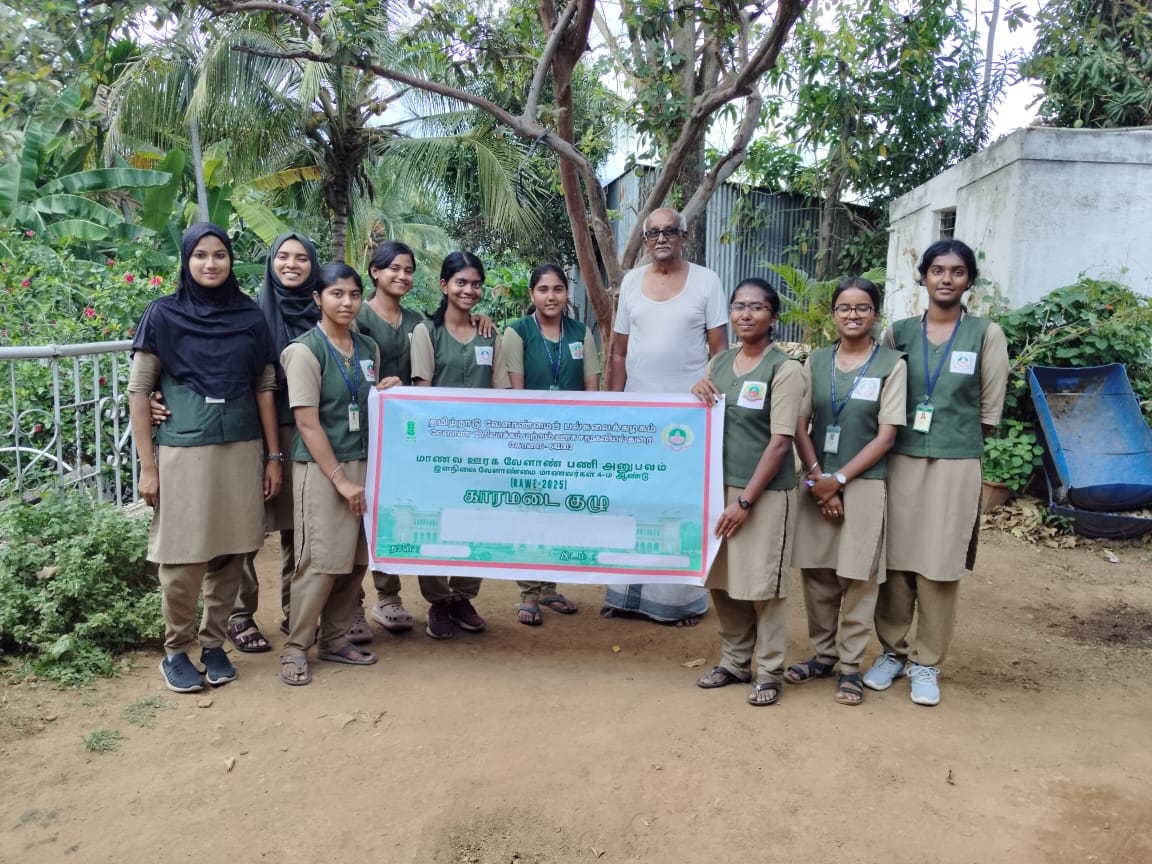
By M. Dhivya, Durga B, Elakkiya N, Fasha Sharif, Dhivya Prabha, Divya B, Dhivya P, Dona Mariya Joseph, Gayathri N, Gaury T Rajendran
From the introduction of the Green Revolution, commercial agriculture has been sustaining the hunger of more than 43 million of India’s population. But are we aware of the hidden costs of modern agriculture?
A shocking report reveals that even mother’s milk contains DDT residues in the range of 3.2 micrograms per gram of fat. Another recent study from Natural Sustainability 2022 shows that fertilizer pollution contributes to about 1 in 7 deaths, especially near farming regions.
To overcome these vulnerable effects, farmers are increasingly practicing environmentally friendly methods like organic farming and natural farming. But have you heard about an existing enhanced form of organic farming? Let us explore this ancient yet revolutionary approach to farming.

The Chemical trap: How modern agriculture lost its way
In the race to boost agricultural productivity, the world turned toward chemical-based solutions. Chemical fertilizers, pesticides, and herbicides promised higher yields and better profits. But behind this green illusion lies a darker truth: chemical farming is corrupting the very essence of life—our soil, health, biodiversity, and the planet.
Healthy soil is a living ecosystem teeming with microbes, earthworms, and fungi. Chemical fertilizers, especially nitrogen, phosphorus, and potassium (NPK), disrupt this balance. As a result, the soil loses its fertility and becomes dependent on synthetic inputs, just like a drug addict.
Returning to our roots
Realizing the dreadful situation that chemical farming has caused, the only solution is progressing toward our forefathers’ farming practices. Some key aspects of traditional farming include diversified cropping systems to reap year-round income, recycling of on-farm resources, mulching and cover cropping to conserve soil and moisture, integration of native breeds of livestock to obtain valuable inputs for organic preparations like cow urine and cow dung, avoidance of external inputs that potentially deteriorate our native soil, crop rotation, agroforestry, and saving local seeds to preserve genetic diversity.
The evolution of biodynamic farming
Back in the 1920s, farmers were really worried that soil quality was decreasing, crops weren’t growing like they used to, and animals were getting weaker. So Rudolf Steiner, an Austrian philosopher who was into science and spirituality, helped farmers by giving lectures in 1924, which kicked off what we now call biodynamic farming.
“A farm isn’t just a piece of land—it’s like a living organism. You got to take care of it as a whole, not just pump chemicals into it,” Steiner told farmers. He instructed them to use natural preparations made with special herbs, plant by lunar cycles, and even consider the energy of the earth and cosmos. It may sound a little unconventional, but the idea was to bring balance back to farming: healthy soil, strong plants, and happy animals.
‘Agricultural astrology’: Understanding the cosmic Connection
Biodynamic farming is often regarded as “agricultural astrology” because it has a profound connection to spirituality through the intertwined nature of physical and metaphysical realms. The approach interconnects every element in the farm, from soil to plants, animals, human beings, and even weeds.
One significant strategy practiced in biodynamic farming is vortex stirring, where a rhythmic stirring motion is given to blend biodynamic preparations. The reason behind this vortex stirring is to enrich the preparations with life force and enhance their potency.
Lunar cycles determine significant farming activities like planting and harvesting. When the distance between moon and earth increases, called ascending days, lasting 13.6 days, the earth breathes out, and growth above ground is considered significant. During these ascending days, farmers perform operations like:
- Sowing seeds in direct seed sowing methods and raising seedlings
- Spraying liquid manures and Panchagavya as foliar sprays
- Spraying BD 501 (Horn silica)
- Harvesting leafy vegetables and fruits
When the distance between earth and moon decreases, called descending days—the earth breathes in, and growth below ground is prominent. During these descending days, agricultural operations include:
- Transplanting seedlings
- Compost making and compost application to fields
- Ploughing
- BD 500 (Horn manure), CPP, and liquid manure application to soil
- Harvesting bulbs and tuber crops
A success story from Tamil Nadu
During a Rural Agricultural Work Experience (RAWE) program in Coimbatore, students encountered Mr. Navaneethakrishan, who practices biodynamic farming in his village Chikkadasampalayam. His farm holds certification from PGS India – Green (Participatory Guarantee System) and PGS India – Organic. Mr. Navaneethakrishan has published a book on biodynamic farming titled “Uyiraatral Velaanmai” in Tamil.
Within a limited area, he practices a multi-cropping system by cultivating sweet lime, guava, papaya, and yam with appropriate spacing. Fig trees in his farm provide additional income. “In our farm, we make boundless efforts to make each component like soil, plants, microbes, and animals blissful. The happier they are, the better the quality of fruits they produce. In turn, healthier and happier human beings who intake our farm-grown fruits,” Mr. Navaneethakrishan explains.
“We make sure that even weeds are not harmed. In case they cause menace, we cover them with mulch cover, rather than spraying toxic herbicides. We truly believe in the influence of earthly forces like plants and microbes with outer space forces like the moon, the stars, and the constellations. We schedule our significant agricultural activities like planting, spraying, and harvesting according to lunar phases.”
Science validates ancient wisdom
The results speak for themselves. Sweet lime grown in
Mr. Navaneethakrishan’s farm is certified with higher amounts of hesperidin and polyphenol content than usual ones, proven by Annagenomics laboratory, a NABL accredited food testing lab in Chennai.
Normal content of total polyphenol is about 440 mg/kg, while fruits grown in his field contain about 980 mg/kg. Normal content of hesperidin is about 73 mg/kg, while fruits from his farm contain about 316 mg/kg. Curcumin content in his farm-grown turmeric is about 64.81%, whereas normally it consists of only about 31.61%.
The farm produces its own organic preparations like CPP (Cow Pat Pit), BD 500, BD 501, liquid manures, and Panchagavya, which act as powerful deterrents of pests and diseases as well as growth enhancers.
The future of farming
The world is moving steadfast toward technology-driven agriculture, but we are forgetting our ancient traditional farming practices. What if we integrate traditional agriculture with technology?
To conclude, it’s appropriate to end with a quote from Rudolf Steiner: “For every human illness, somewhere in the world there exists a plant which is the cure. I believe that there is a healing potential locked inside plants which is integral with their evolution, just as it is part of human evolution to learn to tap this wonderful gift of Nature.”
The biodynamic farming revolution represents more than just an agricultural method—it’s a return to harmony with nature, proving that ancient wisdom and modern science can work together to create a sustainable future for farming and food security.

About the contributor:
Dhivya M is doing her final-year B.Sc. (Hons.) Agriculture at Tamil Nadu Agricultural University (TNAU), Coimbatore. Growing up with a deep curiosity about nature and farming, she chose agriculture. During her academic journey, she participated in the RAWE (Rural Agricultural Work Experience) programme in the Karamadai block, Coimbatore, Tamilnadu. This hands-on exposure helped her witness real-world agricultural practices, challenges, and innovations at the grassroots level. Inspired by that experience, she co-authored an article with her peers to shed light on the insights they gathered during our field visits