The colonial myths you’ve been served with your latte are as fake as “chai tea”. Read on
In the high rises of Dubai’s financial district, executives sip the same beverage that fuels construction workers toiling in 45-degree heat: karak chai.
This sweet, cardamom-scented tea, served in paper cups for as little as Dh1.50 (£0.32), has achieved something remarkable in the Gulf’s stratified societies; today, it has become a great equaliser.
The story of karak chai reveals how migration, entrepreneurship and cultural adaptation can transform a colonial-era beverage into a billion-dollar phenomenon.
What began as kadak chai on Indian streets has evolved into the Gulf’s unofficial drink, generating an economy that spans from roadside stalls to international franchises.
Yet many myths and false narratives continue to be promoted, especially by bloggers and even mainstream media that must match many vested interests.

The Colonial Roots of a Democratic Drink
The foundation of modern chai culture lies in an unlikely source: British imperialism. When the East India Company established vast tea plantations in Assam during the 19th century, they inadvertently set in motion a cultural revolution.
The British promoted tea consumption among Indian workers to create a domestic market for surplus production. But Indians didn’t simply adopt British tea-drinking habits. They transformed them. After all, Indians knew about tea much before the British, and while in the game of narratives, Indians lagged behind, in terms of moral temperament, they were still a step ahead.
The game-changer came in the 1960s with the Crush-Tear-Curl (CTC) method of processing tea. This mechanised technique produced small, hard pellets perfect for the Indian style of vigorous boiling with milk and spices.
Crucially, CTC tea was cheap, making it accessible to the masses. The chaiwallah emerged as a fixture of Indian life, brewing potent cups for a few rupees at railway stations and street corners.
The Linguistic Journey: From Kadak to Karak
The transformation of the beverage’s name tells its own story of cultural migration. In Hindi, “kadak” means strong or stiff, which is a direct reference to the tea’s robust character. The word traces its etymology through Prakrit from the Sanskrit “kathin,” meaning hard. The name was about identity: kadak chai was deliberately brewed to jolt the senses awake.
The shift to “karak” in the Gulf was linguistic adaptation. Historical analysis suggests the retroflex ‘?’ sound in Hindi posed difficulties for Arabic speakers, much as it had for Mughal rulers in India centuries earlier.
When South Asian migrants introduced their strong tea to the Gulf, “karak” emerged as the natural phonetic compromise; it was easier for Arab tongues while maintaining the essence of strength.
This evolution mirrors the beverage’s own transformation. Just as the name adapted to fit local pronunciation, the recipe evolved to suit Gulf palates. The renamed “karak” became sweeter, creamier, more luxurious than its Indian predecessor.
The linguistic shift from kadak to karak thus serves as a perfect metaphor for the drink’s journey: a product reshaped by its new home while retaining its fundamental identity as the strong, fortifying brew that gives workers and executives alike their daily jolt.

From Ancient Courts to Modern Streets
The DNA of karak chai stretches back millennia, long before tea leaves ever reached India. Ancient Indian royalty consumed kashayam, the local name for spiced herbal decoctions designed to sharpen the mind during lengthy court sessions.
These caffeine-free brews, rooted in 5,000-year-old Ayurvedic traditions, established the principle of using spices for both medicinal and stimulating purposes. When the British finally introduced tea to India, the people merged it with their ancient spice wisdom.
The most transformative moment came during India’s independence movement in the 1940s. Chai, once viewed as an imperialist imposition forced upon plantation workers, underwent a remarkable metamorphosis.
Indians reclaimed and reinvented the beverage so thoroughly that it became a symbol of economic self-reliance and national identity. The British had created the plantations, but Indians created the culture; they turned their coloniser’s drink into something uniquely their own.
In the Gulf, this story of reinvention continued through ingenious adaptations. When fresh milk was scarce and expensive in the 1970s, cafeteria owners turned to Rainbow brand evaporated milk from the Netherlands.
What began as a practical necessity, as canned milk didn’t require refrigeration, became the signature element that distinguished Gulf karak from Indian chai.
Today, that distinctive creamy sweetness from evaporated milk is so integral to the drink’s identity that using fresh milk would be considered inauthentic. Sometimes, constraints create classics.

The Art of the Perfect Brew
The preparation of authentic karak chai is as much ritual as recipe. Unlike Western tea-making’s gentle infusion, karak demands vigorous decoction; it is a method that would horrify tea purists but delights millions daily. The process begins with crushing fresh cardamom pods to release their aromatic oils, then boiling them with water to create a fragrant base.
Strong CTC tea is added and boiled hard for several minutes until the liquid turns deep mahogany. Then comes the transformation: evaporated milk is poured in, along with generous spoonfuls of sugar, and the mixture is brought to a rolling boil before being reduced to a simmer.
This slow cooking is crucial as it allows the milk proteins to break down and the sugars to caramelize slightly, creating that signature velvety texture and rich color.
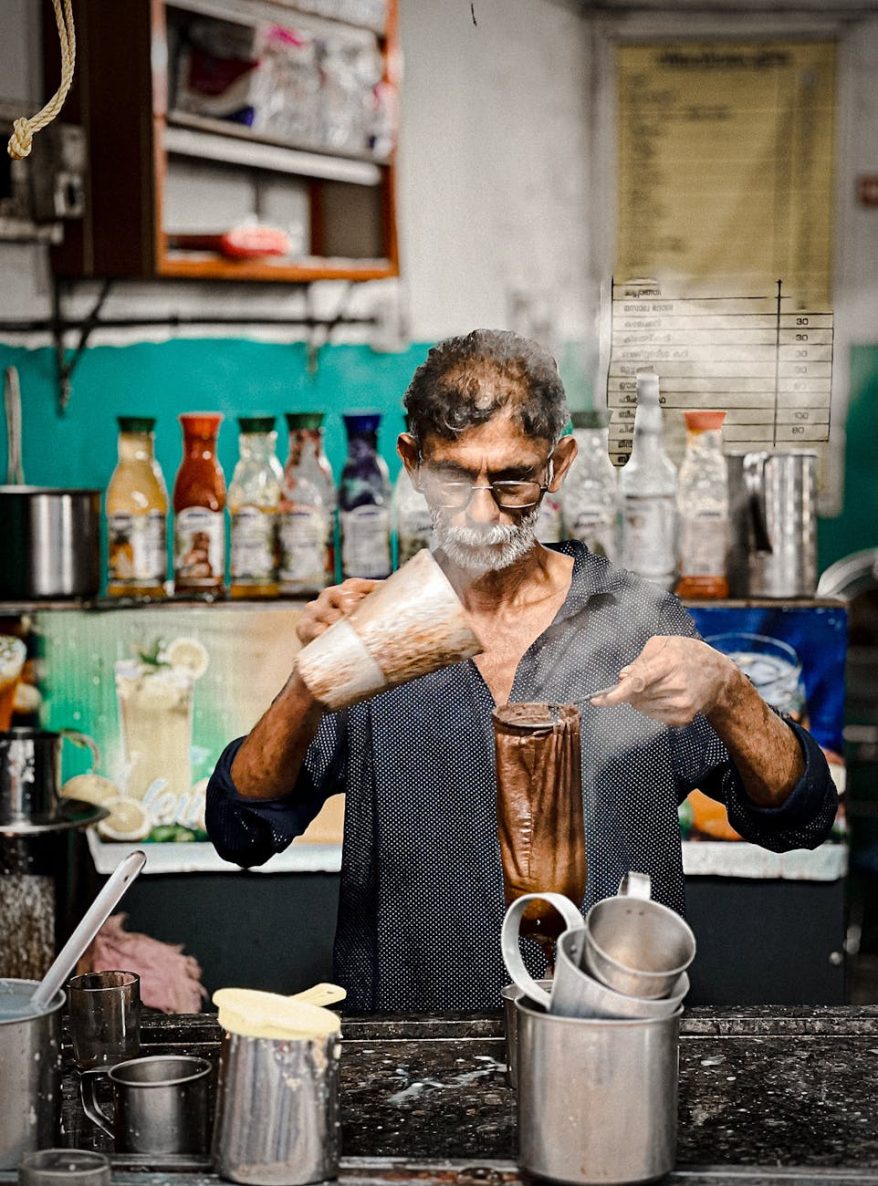
Street vendors add theatre to the process, repeatedly pouring the chai from height between vessels. It is a technique called “pulling” that aerates the liquid and creates a satisfying froth. The entire process takes 10-15 minutes, a deliberate slowness in an instant world.

Deconstructing the Colonial Mythology
The story of tea, as told in Western media and countless lifestyle blogs, is riddled with colonial fiction masquerading as history. These myths not only distort the past but perpetuate a narrative that erases indigenous knowledge and labour.
Take the persistent myth that Britain introduced tea to India. In reality, the Singpho people of Assam had been cultivating and brewing the native tea for generations before Robert Bruce’s supposed “discovery” in 1823.
Bruce wasn’t an explorer stumbling upon virgin wildernessl; he was guided by locals who showed him their traditional tea-making practices. As early as the 12th century, the Singpho were toasting tea leaves and packing them into bamboo canes for preservation, demonstrating sophisticated processing techniques long before any European arrival.
As Dr Gautam Saikia, Professor, Department of Tea Husbandry and Technology at Assam Agricultural University, observed: “This wasn’t “wild” – as the East India Company built its narrative twist. It was agriculture, with firm fundamentals, adapted perfectly to the local ecosystem. The Singpho understanding of tea also extended beyond simple cultivation; they used it as food, medicine and a central element of their cultural practices.”
Even more telling is John Ovington’s 1689 account from Surat, where Indian traders were already brewing imported Chinese tea with “hot spice…sugar-candy” and “conserv’d lemons”, essentially proto-chai, over a century before the British began their plantations. Indians weren’t taught to drink tea; they were already adapting it to their ancient traditions of spiced medicinal decoctions called kadhas.
Even more pernicious is the myth of benevolent British tea culture spreading to grateful colonies. The truth is far darker. The establishment of Indian tea plantations involved violent land seizures, massive deforestation, and an indentured labour system so brutal that mortality rates approached 50% in the early years.
When the Great Depression collapsed tea exports in the 1930s, the British didn’t “share” their tea culture with Indians out of goodness; in fact, they launched aggressive marketing campaigns to offload surplus stock, creating a domestic market out of economic desperation.
Perhaps the most absurd myth, repeated endlessly in Western cafes, is that chai is an ancient 5,000-year-old beverage. While Indians did consume spiced medicinal decoctions called kadhas for millennia, the specific drink we know as masala chai is a thoroughly modern invention. As mentioned, it emerged in the 20th century when Indians took cheap British CTC tea and transformed it into something entirely their own.
The British tea propagandists of the 1920s were horrified when Indians “flouted almost every single axiom” of proper tea-making, boiling everything together in what historian Gautama Bhadra called a “grassroots culinary rebellion.”
The “chai tea” served in Western coffee chains (itself a linguistic redundancy as chai means tea) bears little resemblance to either ancient Indian traditions or modern street chai. It’s a third-generation interpretation, sweetened and homogenised for Western palates.
In the Gulf, similar myths obscure the true story. When outlets celebrate karak as a “democratizing” drink, they often erase the South Asian migrant workers who introduced it during the 1960s oil boom.

The Gulf Migration Wave
The 1970s oil boom created an unprecedented demand for labour in the Gulf states. Among the millions who answered the call were migrants from Kerala, particularly from the Muslim community, which had centuries-old trading links with Arabia.
These migrants brought their tea-drinking habits and entrepreneurial instincts.
The Keralite diaspora, now numbering over 2 million in the UAE alone, quickly dominated the affordable food service sector.
Their cafeterias, often little more than a counter with a gas burner, became social institutions. They adapted the recipe to local tastes: fewer spices, more sweetness, and crucially, evaporated milk instead of fresh. It was a practical choice when refrigeration was scarce.
A Unifying Force
In societies where South Asian labourers rarely interact with Emirati citizens, karak chai performs a unique social function. The beverage crosses boundaries that few other cultural products can breach.
The sight of Land Cruisers pulling up to modest cafeterias, their occupants honking for service, has become an iconic image of Gulf life.
This democratising effect hasn’t gone unnoticed by entrepreneurs. Filli Cafe, founded in Dubai in 2004, has expanded to over 100 outlets across 15 countries, serving karak chai alongside acai bowls and avocado toast.
The Numbers Behind the Brew
The global masala chai market, valued at $5.49 billion in 2023, is projected to reach $9.75 billion by 2031, according to Verified Market Research. The UAE’s tea market alone is growing at 15% annually, driven largely by karak consumption.
These figures reflect broader trends: the global shift towards “authentic” beverages, the rise of tea as a coffee alternative, and the purchasing power of the Gulf’s multicultural population. A single Dubai event in 2018 served 5,000 litres of karak to 45,000 visitors in one day!

Future Prospects
As karak chai goes global, it faces new challenges. Western markets demand lower sugar content and dairy alternatives. Sustainability concerns are pushing brands towards organic, ethically sourced ingredients.
For entrepreneurs, karak represents a case study in cultural adaptation and market opportunity. Its journey from colonial tea plantations to global cafe chains demonstrates how migration, innovation and cultural fluency can create entirely new market categories.
As one Dubai venture capitalist puts it: “Karak isn’t just tea—it’s nostalgia and cultural bridge all in one paper cup. That’s a powerful value proposition.”
Watch the story here