
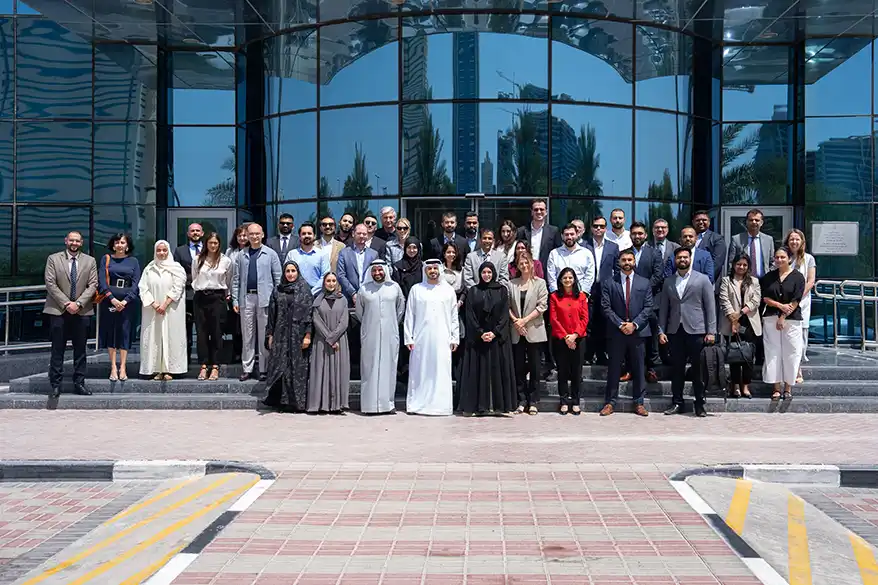
DUBAI, September 21, 2025 – In line with its continued commitment to strengthening the role of the private sector as a key partner in achieving the national targets, the Ministry of Climate Change and Environment (MOCCAE), in collaboration with the UAE Alliance for Climate Action (UACA), convened a session to discuss ways to support companies and non-governmental organisations in advancing climate action and driving sustainable growth in the UAE.
To better support private sector stakeholders, the session focused on deepening partnerships, familiarising stakeholders with national climate action priorities, and initiating constructive dialogue to align their operations with national targets. Furthermore, the meeting explored mechanisms and tools to facilitate their effective contribution to the country’s climate objectives.
The UAE has reaffirmed its commitment to climate leadership with the implementation of Federal Decree-Law No. (11) of 2024 on the Reduction of Climate Change Effects. This landmark legislation, which came into effect on 30 May 2025, provides a comprehensive framework to guide the nation towards achieving its ambitious climate targets. The new law also sets out guidelines for private sector stakeholders on how they can contribute to achieving the national objectives aimed at reducing emissions.
The UAE’s national approach is centred around empowering the private sector and establishing clear frameworks to enhance its contribution to the country’s ambitious climate goals. This approach is built on the principle of transparency and supports companies in measuring and reporting their emissions, thereby enabling them to make strategic decisions based on accurate data.
This vision also encourages effective partnerships between the public and private sectors to accelerate innovation, create green jobs, and stimulate low-carbon economic growth. To support these efforts, national mechanisms have been developed to incentivise and monitor emission-reduction initiatives, thereby strengthening collaboration across stakeholders and driving the transition towards a green and sustainable economy.

A Key Pillar for Achieving Net Zero by 2050
Her Excellency Dr. Alanoud Alhaj Al Ali, Acting Assistant Undersecretary for Green Development and Climate Change sector at MOCCAE, stated: “The UAE is committed to a collaborative development model, uniting government, the private sector, and all stakeholders to achieve the nation’s climate objectives, most notably Net Zero by 2050—an ambition demanding determined collective action. It is this commitment that paved the way for our session in collaboration with UACA, and with the participation of strategic partners such as the Environment Agency – Abu Dhabi and various energy operators across the country. The session aimed to equip companies with the information, tools, and confidence to translate ambition into tangible results.”
Her Excellency added: “By aligning private sector leadership with our national priorities, we are laying the foundation for a climate-resilient and prosperous future for the UAE. Through this law the UAE has set global benchmarks for climate leadership, showing that economic prosperity and environmental protection are not mutually exclusive.”
Laila Mostafa Abdullatif, Director General of Emirates Nature–WWF, commented: “UACA was established to catalyse ambitious climate action from private sector stakeholders. This partnership with MOCCAE exemplifies how public–private collaboration can drive systemic change. Understanding the national climate priorities is not just about compliance; it is about enabling companies to unlock green innovation, future-proof their operations, and contribute meaningfully to the UAE’s net-zero journey.”
Constructive Discussions
The session, held at the Ministry of Climate Change and Environment headquarters in Dubai, focused on creating a national platform that brings together the private sector and relevant stakeholders to exchange expertise and align visions. The aim was to achieve national climate and environmental objectives, seize opportunities to lead the transition to a low-carbon economy, and support companies in meeting their own related goals, thereby enabling sustainable growth.
During the session, E. Abdelmuti Murad, Director of Climate Change Department at the Ministry of Climate Change and Environment, gave a detailed presentation on how national climate policies can be implemented within the private sector. He highlighted ways to accelerate the adoption of sustainable business practices in line with the UAE’s climate priorities, with a focus on reducing emissions and embracing technologies to reduce the carbon footprint.
The session successfully bridged the knowledge gap between regulatory initiatives and non-state actor implementation. Senior MOCCAE officials delivered a detailed overview of business development requirements to align with the UAE’s climate objectives, and shared practical guidance to support the measurement of carbon footprint and how it contributed to achieving the nation’s Net Zero objectives. The session also highlighted how the National Register for Carbon Credits will function as an enabler of a sustainable, green economy.
Led by Emirates Nature-WWF, UACA is supported by HSBC as a founding donor. The alliance is endorsed by MOCCAE and is responsible for accelerating private sector stakeholders’ decarbonisation in line with science. In this session, UACA’s role was to ensure that the perspectives and needs of its members and the wider private sector stakeholder community were supported throughout the process.
-End-