Exclusive interview with Prof. (Dr.) Gourav Vallabh, Part-Time Member of India’s Economic Advisory Council to the Prime Minister
India is charting a distinctive path – one that transforms a decades-old consumption-driven economy into a strategic powerhouse, says Prof. (Dr.) Gourav Vallabh, Part-Time Member of India’s Economic Advisory Council to the Prime Minister. “We’re neither criticizing anyone nor declaring what’s good or bad. We’re making our own path.”
That path, as Prof. Vallabh explains, is built on remarkable metrics. Despite geopolitical headwinds, he says that the nation maintains a growth rate of 6.1-7% with inflation holding steady at 3-4% – numbers that no other major economy can match. By 2028, India is poised to become the world’s third-largest economy after the US and China.
But beyond the numbers lies a more profound transformation. India is breaking free from what Prof. Vallabh calls the “vicious cycle” of poverty through systematic reforms. In the last decade alone, 17 crore people have been lifted out of extreme poverty. The government has opened 56 crore new bank accounts, housing their collective savings of 2.4 lakh crore rupees. “These numbers represent a fundamental shift in quality of life,” he says.
This economic reset is perhaps best illustrated by India’s strategic approach to development, according to Prof. Vallabh. The country has moved beyond reactive policymaking to what he terms “third generation reforms” or Reforms 3.0, focused on direct delivery of services to citizens.
From digital payment systems that enable even street vendors to accept cashless transactions, to comprehensive social security measures like Ayushman Bharat for health coverage, India, he says, is engineering a virtuous cycle where increased consumption drives production, employment, and further growth.

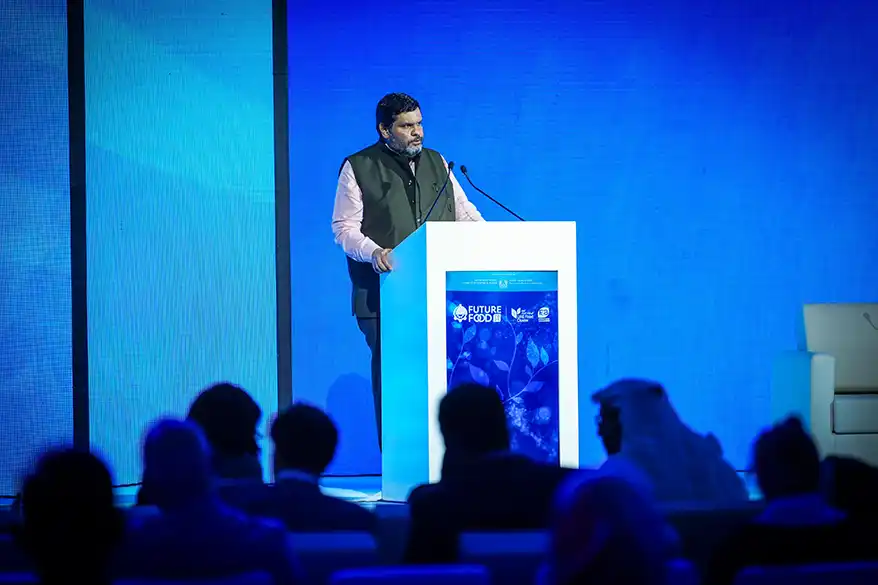
Speaking at the Future Food Forum in Dubai, Prof. Vallabh presented a vision of Indo-UAE collaboration that extends far beyond traditional trade partnerships. The cornerstone of this collaboration is the India-UAE Food Security Partnership, which has become a key pillar of the Comprehensive Economic Partnership Agreement (CEPA) established during the bilateral virtual summit between the leaders of both nations in 2022.
The seasoned economist and public policy expert, who serves as Professor of Finance at XLRI and holds multiple professional qualifications including being a Certified Financial Risk Manager, emphasized the strategic importance of the $2 billion UAE investment in Indian food parks.
The partnership’s scope is ambitious, he told the gathering, attended by UAE’s Minister of Economy & Tourism Abdullah bin Touq. “This initial investment opens the path to a larger goal of facilitating up to $7 billion in investments from UAE companies.”
This foundational initiative, he explained, rests on three key components: significant infrastructure development including state-of-the-art food processing units and climate-controlled storage facilities; a comprehensive “farm-to-port” infrastructure to streamline agricultural product movement; and technology integration focusing on climate-smart farming practices and digital platforms for supply chain optimization.
But perhaps most significantly, the partnership is driven by three strategic sub-themes that Prof. Vallabh detailed in his address. The first focuses on deep market integration – moving beyond CEPA’s tariff lines to create real trade density. “In H1 2025, non-oil trade reached $37.6 billion, up 34% year-on-year,” he noted. “CEPA covers 80% of tariff lines with zero-duty access on 90% of India’s exports. But the headline numbers are only a foundation.”
The second sub-theme addresses strategic supply-chain sovereignty. With market infrastructure in place, both nations can anchor supply chains for essentials, particularly in food and pharmaceuticals. The UAE’s Food Security Strategy 2051 aims for global top rank and tripling domestic food output by 2030, creating several competitive levers for collaboration.
The third focuses on scaling South-South Governance & Finance Architecture. “This is the lever for global impact,” Prof. Vallabh explained. “We can take bilateral operational models and make them templates for the Global South. India-UAE corridors can fund and govern infrastructure projects in Africa and South Asia, blending public, private, and concessional finance.”
Prof. Vallabh sat down with The Fourth Plate for an extensive discussion about India’s economic transformation and its implications for global food security:
Q: Your speech emphasized the strategic nature of India’s growth. How does this reflect in the broader economic climate?
By 2028, we will be the third largest economy in the world after the US and China. From historical days, if we talk about the last 10-20 years, India was more a consumption-driven economy – we produce, we manufacture, we consume, and that was the major thrust to move the wheel of the economy.
Today, we’re strategic rather than reactive. The Prime Minister’s vision extends to 2047, with a clear mathematical framework: we need to double our per capita income every 10-11 years. As we’re now in 2025, with 22 years to 2047, this means doubling income twice in that base period to achieve our development goals.
Despite the current geopolitical scenario, the Indian economy is expected to grow at 6.5-7% in the next three years. These are the predictions by global and international agencies like IMF and World Bank. The current inflation in the economy is between 3-4%. There is no large economy in the world which is growing or expected to grow in the next 3-5 years at 6.5-7% with expected inflation around 3%.
Q: Could you elaborate on the third-generation reforms driving this transformation?
A: The last 11 years under Prime Minister Modi focused on third-generation reforms in India, emphasizing public delivery. We implemented a new education policy, replacing the one from the 1990s, with focus on digitization, machine learning, artificial intelligence, and robotics. This makes India a shining star in the global economies.
Take the GST rate reduction announced today – who gets the major benefit? Indian manufacturers and MSMEs. The Prime Minister addressed the nation, announcing GST reductions and appealing to people during this festive season – from Navratri to New Year and Christmas – to empower Made in India products, MSMEs, and larger companies.
This festive season timing is strategic – from Navratri through New Year, the reduced GST rates will stimulate spending when people are most likely to make purchases, maximizing the economic impact. This demonstrates how policy timing can amplify economic benefits.
With no tax up to 12 lakh rupees of income announced in the Union Budget 2025, complemented by GST rate reduction, consumption in the economy will increase by 5.31 lakh crore, or ?5.31 trillion. As the Prime Minister says, buy products where India’s sweat is invested.
Further, under the Mudra scheme, we’ve provided loans to 33 crore MSMEs, with average ticket sizes of 25,000-30,000 rupees. Through Ayushman Bharat and the Pradhan Mantri Housing Scheme, 2.1 crore families received houses. These initiatives create what I call a virtuous cycle: when consumption grows, production increases, leading to more manufacturing and employment.

Q: How is this growth translating into development on the ground?
A: Look at the numbers – in the last decade, we’ve generated 17 crore new employment opportunities. India now has over 100 unicorns, the highest number globally. Our digital infrastructure, particularly UPI, has democratized financial access with street vendors now accepting digital payments without additional costs.
In the last 11 years, 56 crore new bank accounts were opened under Jan Dhan Yojana – more than the population of many continents. The current balance in these accounts is around 2.4 lakh crore. Under the Mudra scheme, 33 crore MSMEs received loans, with average ticket sizes of 25,000-30,000 rupees.
Q: The India-UAE partnership seems to be a model for South-South cooperation. Could you elaborate on its strategic importance?
A: The cooperation between India and the UAE is truly a model for Global South collaborations. The India-UAE Food Security Partnership, incorporated into CEPA, aims to create a resilient and diversified food supply chain by leveraging each country’s strengths. The UAE contributes capital and hubs, while India brings scale – together, we can export South-South corridors that de-risk the most vulnerable supply chains and shape new standards for the Global South.
Q: What are the key challenges in implementing these partnerships?
A: Most gaps aren’t about ambition: India and the UAE have strong legal frameworks and shared visions. The major challenges are in operationalization, joint governance, and scale-up mechanisms. There’s what I call a CEPA Utilization Gap – many exporters lack awareness or capacity to fully leverage CEPA provisions. Regulatory complexity and certification requirements still create friction.
We also face challenges in supply chain integration. Despite India being a major producer of pulses, rice, dairy, and pharma ingredients, strategic UAE buffers or joint processing hubs are minimal. Trade flows remain transactional rather than embedded in resilient, long-term supply chains.
Q: How is India addressing its agricultural sector in this context?
A: We’re taking multiple strategic steps. First, we’ve expanded the number of crops covered under Minimum Support Price. Through the Pradhan Manthan Nidhi, every agricultural family receives direct benefit transfers of ?6,000 annually.
Initiatives like ‘more crop per drop’ improve output efficiency. Organic farming is gaining momentum – some states are 100% organic now. To reduce misuse of pesticides and urea, we’ve implemented name-coding so it can’t be diverted to other industries.
The agricultural sector maintains a steady 3.5-4% growth rate, significantly higher than pre-2014 levels. The Prime Minister is particularly concerned about rural economy and agriculture processing.
What’s particularly exciting is our focus on food processing. In the current Union Budget, we announced a Makhana Board – makhana being a significant crop in Bihar requiring processing. We’ve also implemented name-coding for urea to ensure it reaches farmers. The agricultural sector maintains a steady 3.5-4% growth rate, significantly higher than pre-2014 levels.
Animal husbandry is another priority. The Prime Minister believes the agricultural sector can grow rapidly with proper support to animal husbandry, as most farmers traditionally maintain livestock. When farmers invest across these sectors – in education for their children, better health for families, and improved living standards – the economic cycle strengthens further.
Q: The government recently announced significant deregulation initiatives. What’s the vision behind this?
A: The Finance Minister, in her 2025 budget presentation, emphasized deregulation. The government aims to improve both ease of living and ease of doing business. We’ve scrapped more than 1,600 obsolete laws, and in every sector – licensing, monitoring, environmental clearances – the government is thinking about deregulation to reduce compliance burden from both cost and mindset perspectives.
The government has also increased disposable income through tax reforms. When consumption grows by 5.31 lakh crore, production must increase, requiring more employment. This creates a cycle: consumption grows, production rises, manufacturing increases, employment expands, leading to more disposable income and further consumption growth.

Q: How do you view the current global recalibration between countries?
A: While I’m not an expert in this area, we’ve seen de-globalization and economic nationalism initiated by many nations in recent years. India remains constant with its policies, framework, and design. We maintain dialogue with almost every country worldwide, except one. We believe problems can be resolved when people sit at the table.
It’s important to note that India isn’t volatile. We’re moving ahead with our own agenda, neither criticizing anyone nor declaring what’s good or bad. As we say in Hindi, “hamari apni raah bana rahe hain” – we’re making our own path. While most nations are reacting to global events, India maintains a strategic rather than reactive approach. We’re not answering to others’ actions; instead, we’re building our future based on our strengths and vision.
Our strengths lie in our demographic dividend, consumption-based economy, strong democratic setup, high sovereign rating, and the unique combination of high growth with low inflation. No other country has these advantages together. We’re hopeful that current geopolitical situations will be resolved soon. As our Prime Minister often mentions, global prosperity can only come through global peace.