
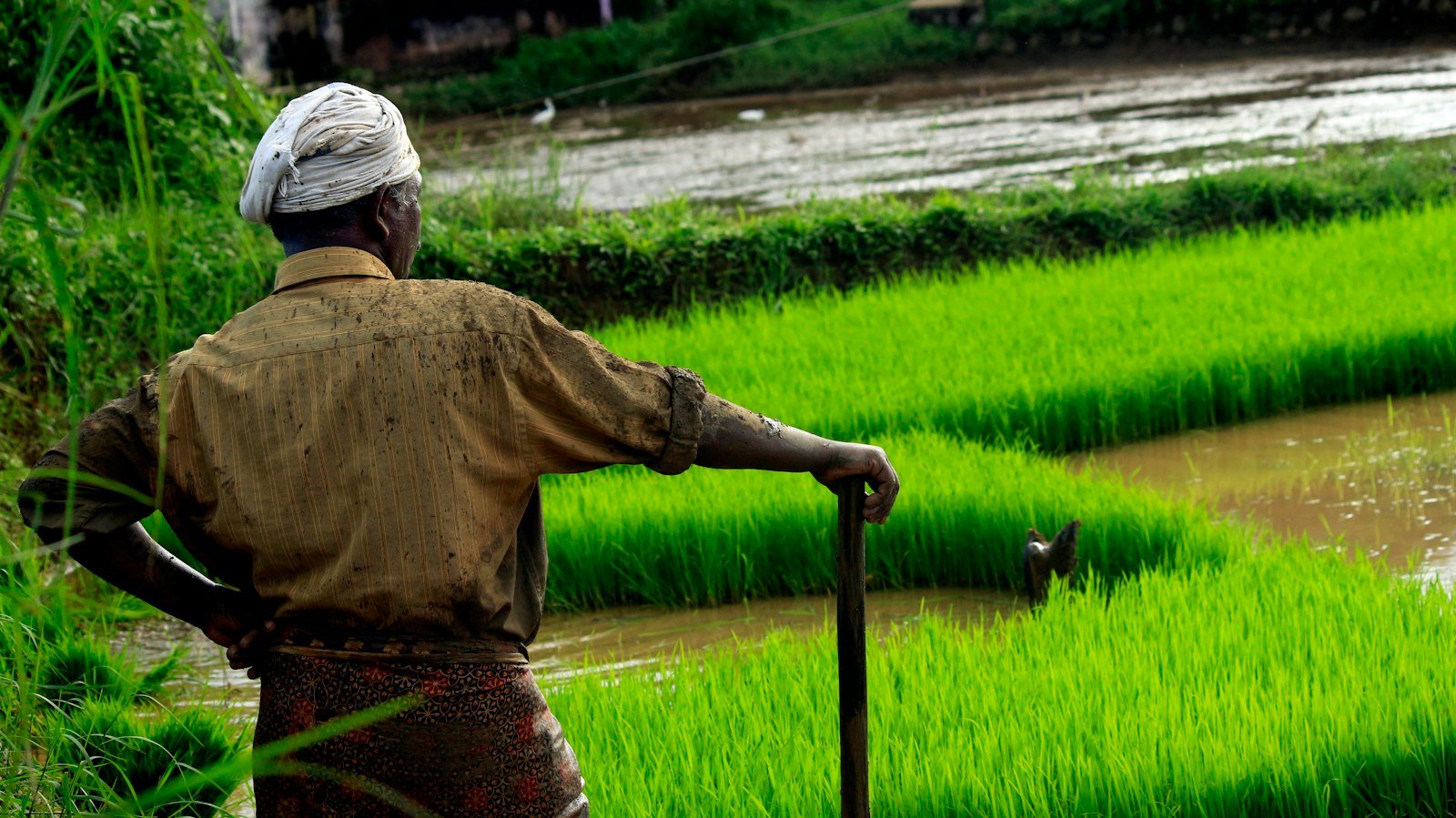
The fertiliser subsidy in India is budgeted at Rs 1,70,799 crore for 2026-27, about US$18 billion. It fixes the farmgate price of urea at Rs 242 for a 45 kg bag. Farmers pay that price whatever urea costs on world markets, and the Union government pays the gap to manufacturers and importers.
That one rule shapes almost everything else in Indian farming inputs. It explains why urea dominates sales and soils run short of phosphorus and potash. It also explains why the 2026 shipping crisis in the Strait of Hormuz landed on the Union Budget before it reached farmers. This guide explains how the system works and gives the latest official figures, with dates.
Key facts
- Urea sales reached 396.60 lakh tonnes in 2025-26, a record (Department of Fertilizers, Lok Sabha reply, 24 July 2026)
- Urea costs farmers Rs 242 per 45 kg bag, unchanged since March 2018 (PIB, August 2025; PRS Legislative Research, 2026)
- DAP costs Rs 1,350 per 50 kg bag, kept unchanged for kharif 2026 (Ministry of Chemicals and Fertilizers, 2026)
- India imported 26% of its urea and 61% of its DAP in 2025-26, measured against sales (Lok Sabha reply, July 2026; Fourth Plate calculation)
- Potash (MOP) is wholly imported (PIB, August 2025)
- India’s N:P:K use ratio was 10.9:4.4:1 in 2023-24, against an agronomic ideal of 4:2:1 (Standing Committee, cited by PRS, 2026)
- Fertiliser use averaged 150.1 kg of nutrients per hectare in 2024-25 (Fertiliser Association of India, 2025)

What fertilisers Indian farmers use
Indian farmers use five main products, and each supplies a different mix of the three primary nutrients: nitrogen (N), phosphorus (P) and potassium (K). Urea is 46% nitrogen and is the cheapest nutrient on the market because its price is fixed by law.
Di-ammonium phosphate, or DAP, contains 18% nitrogen and 46% phosphate and is the second-largest product by volume. Muriate of potash, or MOP, supplies potassium at 60% K2O. NPK complexes such as 10:26:26 and 20:20:0:13 combine two or three nutrients in one granule. Single super phosphate, or SSP, is a low-strength phosphate fertiliser with sulphur and calcium, made mostly by small domestic plants.
In 2025-26 farmers bought 396.60 lakh tonnes of urea and 150.37 lakh tonnes of NPK complexes. DAP sales were 100.80 lakh tonnes and MOP 22.56 lakh tonnes, the Department of Fertilizers told the Lok Sabha on 24 July 2026. Urea sales rose 10.8% in two years, from 357.81 lakh tonnes in 2023-24.
The Fertiliser Association of India (FAI) puts total product consumption at about 70.7 million tonnes in 2024-25. In nutrient terms India used 32.93 million tonnes of N, P2O5 and K2O, or 150.1 kg per hectare, up from 139.7 kg a year earlier.
How the fertiliser subsidy works in India
India runs two subsidy systems. Urea sits under direct price control, and every other fertiliser sits under the Nutrient Based Subsidy (NBS) scheme, which began in April 2010.
Urea and the fixed MRP
The government notifies a single maximum retail price (MRP) for urea of Rs 242 per 45 kg bag, about Rs 5.38 per kg. Manufacturers and importers sell at that price and receive the difference between their delivered cost and the MRP as subsidy. The urea subsidy has three parts, PRS Legislative Research says: domestic production, imports and freight.
A rough calculation shows the size of the transfer. The 2026-27 Budget leaves about Rs 1.17 lakh crore for urea once NBS is deducted. Divided by 2025-26 urea sales of 396.60 lakh tonnes, that is about Rs 29,450 per tonne, or roughly Rs 1,325 for every Rs 242 bag. The real figure for 2026-27 will be higher, because world urea prices roughly doubled through April 2026, according to the International Food Policy Research Institute (IFPRI).
The Nutrient Based Subsidy for P and K
Under NBS the government fixes a subsidy per kilogram of nutrient, twice a year, and companies set their own MRPs. For kharif 2026, from 1 April to 30 September, the Union Cabinet set Rs 47.32 per kg of N and Rs 52.76 per kg of P. Potassium gets Rs 2.38 per kg and sulphur Rs 3.16. These are the latest Cabinet-approved rates published as of 4 November 2026. The tentative outlay for the season is Rs 41,533.81 crore across 28 grades, the Cabinet said on 8 April 2026.
Applied to a bag, those rates reveal the policy. A tonne of DAP carries 180 kg of N and 460 kg of P. Its subsidy is (180 x 47.32) + (460 x 52.76), or Rs 32,787 per tonne. That is Rs 1,639 on a 50 kg bag that the farmer buys for Rs 1,350. A tonne of MOP carries 600 kg of K, so its subsidy is Rs 1,428 per tonne, or Rs 71 a bag. Phosphate is heavily supported and potash barely at all.
Current fertiliser prices per bag
Urea costs Rs 242 per 45 kg bag and DAP Rs 1,350 per 50 kg bag across India. Prices for MOP, NPK complexes and SSP vary by company and state, and rose sharply in 2026.
| Product | Bag | Farmer price | Source and date |
|---|---|---|---|
| Urea | 45 kg | Rs 242 (fixed) | PIB, August 2025 |
| DAP | 50 kg | Rs 1,350 | Ministry of Chemicals and Fertilizers, March 2026 |
| MOP | 50 kg | Rs 1,975 (Rs 1,535 a year earlier) | MP State Cooperative Marketing Federation, May 2026 |
| NPK 10:26:26 | 50 kg | Rs 2,450 (Rs 1,720 a year earlier) | MP State Cooperative Marketing Federation, May 2026 |
| NPK 16:16:16 | 50 kg | Rs 2,050 (Rs 1,475 a year earlier) | MP State Cooperative Marketing Federation, May 2026 |
| Granular SSP | 50 kg | Rs 605 (Rs 505 a year earlier) | MP State Cooperative Marketing Federation, May 2026 |
The non-urea prices are Madhya Pradesh cooperative rates for kharif 2026, reported by Rural Voice on 27 May 2026; the federation expected similar levels in other states. The ministry put the 2025-26 national average at Rs 1,814.82 a bag for NPK 10:26:26, Angel One reported.
The gap between Rs 242 urea and Rs 2,000-plus complexes is the core problem. A farmer who pays by the bag buys the cheap one.
How much India spends on fertiliser in the Union Budget
The Union Budget 2026-27 sets India’s fertiliser subsidy at Rs 1,70,799 crore, about 3.2% of total Union spending, PRS Legislative Research says. That is about US$18.0 billion at the Reserve Bank of India reference rate of Rs 94.86 per dollar on 3 November 2026.
NBS gets about Rs 54,000 crore, according to budget analyses by Multibagg and FertiliserIndia, which leaves about Rs 1.17 lakh crore for urea. Minister of State Anupriya Patel told the Rajya Sabha on 21 July 2026 that Rs 70,709 crore had been spent by 13 July. She put the allocation at Rs 1.77 lakh crore; this guide uses the PRS figure of Rs 1.71 lakh crore.
The budget was drawn up in February 2026, before the Gulf conflict escalated. Aparna S Sharma, Additional Secretary in the Department of Fertilizers, said on 4 May 2026 that costs had risen and “there will surely be an increase”, PTI reported. Crisil Ratings estimated the bill could rise 12-15% above the budget if high costs lasted a quarter.
Past spending points the same way. Patel put disbursement at Rs 1.77 lakh crore in 2024-25 and Rs 2.17 lakh crore in 2025-26. The 2026-27 allocation is 21% below what was paid in 2025-26, in a year of rising world prices.
India’s fertiliser imports by product and country
India imported 103.50 lakh tonnes of urea and 61.94 lakh tonnes of DAP in 2025-26, the Department of Fertilizers told the Lok Sabha in July 2026. Set against sales, that puts import dependence at roughly a quarter for urea and NPK, three-fifths for DAP and all of potash.
| Product | Sales 2025-26 (lakh t) | Domestic production 2025-26 (lakh t) | Imports 2025-26 (lakh t) | Imports as share of sales |
|---|---|---|---|---|
| Urea | 396.60 | 293.26 | 103.50 | 26% |
| DAP | 100.80 | 39.01 | 61.94 | 61% |
| NPK complexes | 150.37 | 120.01 | 37.08 | 25% |
| MOP | 22.56 | nil | 29.00* | 100% |
Source: Department of Fertilizers, Lok Sabha Unstarred Question 1021, 24 July 2026. Shares are The Fourth Plate’s calculation. *MOP imports include industrial use.
The headline shares understate exposure. Domestic urea plants run mostly on imported liquefied natural gas (LNG). In 2025-26 the fertiliser sector used 16,762 million standard cubic metres of imported LNG and 2,887 of domestic gas, the same reply shows. Domestic DAP and NPK plants import phosphoric acid, rock phosphate, ammonia and sulphur. The Indian Council for Research on International Economic Relations (ICRIER) puts effective import dependence at 68-70% once those inputs are counted.
Where the imports come from
- The Gulf: Oman is the largest urea source, much of it from the Oman India Fertiliser Company (OMIFCO) plant at Sur, which sits outside the Strait of Hormuz (Takshashila Institution, April 2026). Saudi Arabia’s Ma’aden is the anchor DAP supplier. Qatar is a major urea exporter and an LNG supplier to India. Gulf countries supply about 40% of world urea exports and 23% of DAP exports, IFPRI says.
- Russia: Russia’s share of India’s fertiliser imports rose from 7.68% in 2017-18 to almost 27% in 2023-24, Business Standard reported in October 2025, mainly in urea, DAP and NPK.
- China: Indian imports of Chinese DAP fell from 22.28 lakh tonnes in 2023-24 to 8.47 lakh tonnes in 2024-25 as Beijing restricted exports (PIB, March 2026). India imports about 95% of its specialty water-soluble fertilisers from China, the Soluble Fertilizer Industry Association said in October 2025.
- Africa and elsewhere: Morocco’s OCP is the main phosphate partner. Potash comes from Canada, Russia, Belarus and Jordan, the Takshashila Institution says.
Long-term supply agreements
India locks in supply through long-term agreements, which covered 86.10 lakh tonnes for 2025-26. Saudi Arabia accounted for 31 lakh tonnes, Russia 30.10 lakh and Morocco 25 lakh, the government told the Rajya Sabha in March 2026.
The Saudi deal with Ma’aden supplies 3.1 million tonnes of DAP a year for five years from 2025-26, PIB said. In July 2026 OMIFCO agreed to supply about 1 million tonnes of urea a year to India until February 2031, a company filing reported by Enterprise shows. Patel told Parliament the Oman deal would bring 45 lakh tonnes over five years. For 2026-27, India also agreed 26.50 lakh tonnes of DAP and NPK with Russian suppliers.
The 2026 crisis pushed buyers further toward Africa. A deal with Morocco’s OCP secured 2.5 million tonnes for the season, as The Fourth Plate reported in India’s fertiliser supply chain shifts toward Africa.
What caused the 2026 fertiliser supply crunch
The 2026 crunch began when the Strait of Hormuz closed in March 2026 during the war involving Iran, Israel and the United States. Qatari LNG supplies to India were suspended. Some urea makers, including the Indian Farmers Fertiliser Cooperative (IFFCO), halted plants or brought forward maintenance, Bloomberg reported on 11 March.
Gas availability fell to 60-65% of normal, and urea output at affected units fell by roughly half, an industry official told Khaleej Times in late March. Crisil Intelligence estimated domestic urea output fell 25% in March. World urea prices roughly doubled and DAP rose about 35% through April 2026, IFPRI says. China banned exports of several phosphate and blended products from mid-March, Reuters reported.
India responded with stocks and tenders. Stocks were about 18 million tonnes on 10 March, up almost 37% on a year earlier, Bloomberg reported. Global tenders bought 25 lakh tonnes of urea in April and 17.7 lakh tonnes in June, Patel told Parliament.
Farmers felt little of it at the counter. By 19 July 2026 kharif urea availability stood at 163.78 lakh tonnes against a pro-rata requirement of 109.40 lakh tonnes, the Lok Sabha reply shows. The cost went to the Budget. The Gulf side of the story is in The Fourth Plate’s reports on Gulf economies contracting as Hormuz stays shut and the LNG deals signed at ADIPEC 2026.
Why kharif and rabi crunches recur
Demand comes in two peaks. Kharif paddy, maize and cotton need urea from June to August, and rabi wheat, mustard and chickpea need DAP at sowing in October and November. Shortages appear when imports miss those windows or states fail to move stock to districts. Dealers also force farmers to buy other products with subsidised bags, a practice called tagging.
Rabi 2026-27 needs 380.96 lakh tonnes of fertiliser, including 199.27 lakh tonnes of urea and 55.07 lakh tonnes of DAP. The figures come from government data as of 16 October 2026, reported by AgroSpectrum. DAP was the tightest product: its closing stock covered 1.21 times the October requirement, against 1.95 times for urea and 3.23 times for MOP.
Nano urea and nano DAP and the evidence on them
Nano urea is a liquid nitrogen fertiliser, sold by IFFCO in 500 ml bottles since 2021 and sprayed on leaves. Nano DAP followed.
Uptake has stalled. Sales peaked at 3.26 crore bottles in 2022-23 and fell to 2.07 crore in 2024-25, Patel told the Rajya Sabha in December 2025. IFFCO had submitted no evaluation report on adoption, she said.
Nano products replaced about 1.2 million tonnes of granular urea in 2024-25, Business Standard reported. Against 2024-25 urea sales of 387.92 lakh tonnes, that is about 3% of the market.
The field evidence is divided. Punjab Agricultural University ran a two-year trial in 2020-22 that paired half the recommended soil nitrogen with two nano urea sprays. Wheat yields fell 21.6% and rice yields 13%, with lower grain protein, Down To Earth reported. IFFCO’s own 1,470 demonstrations recorded average yield gains of 5.28% for nano urea and 5.27% for nano DAP. In November 2025 the Indian Council of Agricultural Research (ICAR) began a five-year independent evaluation network.
Until those results arrive, the evidence supports nano urea only as a supplement to soil-applied nitrogen. Nano fertilisers carry no subsidy, PIB said in August 2025.
Soil health, the NPK ratio and the drive against overuse
India applies far more nitrogen than its soils need relative to phosphorus and potassium. The N:P:K ratio of use was 10.9:4.4:1 in 2023-24, against an ideal of 4:2:1, the Parliamentary Standing Committee on Chemicals and Fertilizers found. It blamed the price gap between controlled urea and decontrolled P and K fertilisers.
Imbalance costs yields and money. Excess urea washes into groundwater as nitrate, and missing potash and micronutrients cap the response to nitrogen. Neem-coated urea cuts the amount a farmer needs by about 10%, PIB says.
The Soil Health Card scheme tests 12 parameters, from N, P and K to zinc, boron and organic carbon, and recommends doses for each plot. More than 25 crore cards had been issued by August 2025, IANS and Indian Chemical News reported. Low soil carbon is widespread. The Fourth Plate has reported that 48.5% of Indian soil samples were low in carbon in 2025, in its essay on Surapala’s kunapajala tree manure.
The latest push is Khet Bachao Abhiyan. Agriculture Minister Shivraj Singh Chouhan launched it at Ramsia village in Raisen, Madhya Pradesh, on 1 June 2026. He began the rabi phase from Karnal, Haryana, on 22 October, running to 30 November, All India Radio reported. It promotes soil-test-based fertiliser use, crop diversification, residue management and natural farming. The Fourth Plate covered the rabi launch in India launches Khet Bachao Abhiyan to curb fertiliser overuse.
What India’s fertiliser system means for Kerala farmers
Kerala buys a potash-heavy basket. Its kharif 2026 requirement to 19 July was 0.31 lakh tonnes of urea, 0.21 of MOP, 0.06 of DAP and 0.48 of NPK complexes, the Lok Sabha reply shows.
The Fourth Plate’s calculation from those figures shows the difference. MOP makes up 20% of Kerala’s requirement for the four products, against 5% nationally. Kerala needs 0.68 tonnes of MOP for every tonne of urea; India as a whole needs 0.09. The pattern follows Kerala’s crops: coconut, banana, rubber and spices take far more potash than cereals.
That leaves Kerala heavily exposed to the weakest part of the subsidy. MOP is wholly imported and carries only Rs 71 of subsidy per bag, so its price tracks the world market. In Madhya Pradesh the cooperative price rose from Rs 1,535 to Rs 1,975 a bag between kharif 2025 and kharif 2026. Kerala growers face the same import cost.
Kerala also makes fertiliser. The Fertilisers and Chemicals Travancore (FACT) at Udyogamandal, near Kochi, made 8.20 lakh tonnes of Factamfos (NPK 20:20:0:13) in 2025-26, its annual report says. The grade has more than 30% of the South Indian market, FACT says. The company lost Rs 39.60 crore that year, citing LNG constraints and higher sulphur prices.
For Kerala’s growers the practical lesson is to test soil and match potash doses to the crop. Vani V., profiled by The Fourth Plate in a feature on her natural farm, shows the low-input route on 4.5 acres.
What it means nationally and for Gulf readers
Nationally, the fertiliser subsidy shields farmers from price shocks and moves the risk onto public finances. Each rise in world gas or phosphate prices becomes a Budget problem, and the price gap between urea and other nutrients deepens the soil imbalance.
For readers in the Gulf the link is direct. Oman, Saudi Arabia and Qatar supply much of India’s urea, DAP and LNG, and the 2026 closure of Hormuz showed how a single strait sets Indian farm costs. The OMIFCO urea and Ma’aden DAP agreements now tie Gulf output to Indian fields until at least 2030.
Frequently asked questions
What is the current MRP of urea in India?
Urea costs Rs 242 for a 45 kg bag, or about Rs 5.38 per kg. The price has been fixed by the government since March 2018, PIB says. The government pays suppliers the gap between that price and their cost. On 2026-27 Budget figures the gap is roughly Rs 1,325 a bag, by The Fourth Plate’s calculation.
What is the DAP price per bag in 2026?
DAP costs Rs 1,350 for a 50 kg bag, or Rs 27,000 a tonne. The price stayed unchanged for kharif 2026, the Ministry of Chemicals and Fertilizers said. The government’s Nutrient Based Subsidy adds Rs 32,787 a tonne, or about Rs 1,639 a bag, so the subsidy is larger than the price the farmer pays.
How much is the fertiliser subsidy in the 2026-27 budget?
The Union Budget 2026-27 allocates Rs 1,70,799 crore, about US$18 billion, PRS Legislative Research says. The Nutrient Based Subsidy takes about Rs 54,000 crore and urea most of the rest. Officials said in May 2026 that the bill would rise because of the Gulf crisis. Disbursement in 2025-26 was Rs 2.17 lakh crore.
Which country does India import the most fertiliser from?
No single country dominates. Oman is the largest urea source and Saudi Arabia the anchor DAP supplier. Russia supplied almost 27% of fertiliser imports in 2023-24. India’s long-term agreements for 2025-26 covered 31 lakh tonnes from Saudi Arabia, 30.10 lakh from Russia and 25 lakh from Morocco, the government said.
Is nano urea effective?
The evidence is mixed. A two-year Punjab Agricultural University trial found wheat yields fell 21.6% and rice yields 13% when nano urea sprays replaced half of soil nitrogen. IFFCO’s demonstrations reported yield gains of about 5%. ICAR began a five-year independent evaluation in November 2025, and sales fell to 2.07 crore bottles in 2024-25.
What is the ideal NPK ratio for Indian soils?
Agronomists use 4:2:1 as the benchmark ratio of nitrogen to phosphorus to potassium for Indian conditions. Actual use was 10.9:4.4:1 in 2023-24, the Parliamentary Standing Committee on Chemicals and Fertilizers found. The committee attributed the excess nitrogen partly to the price gap between controlled urea and decontrolled P and K fertilisers.
Fourth Plate coverage
- India’s fertiliser supply chain shifts toward Africa reports how Hormuz disruption pushed Indian buyers toward Moroccan and Egyptian suppliers
- India launches Khet Bachao Abhiyan to curb fertiliser overuse covers the rabi 2026 soil health and balanced-fertiliser campaign
- Gulf economies contract further as Hormuz stays shut reports IMF data on the Gulf economic cost of the closure
- ADIPEC 2026 LNG deals take ADNOC into Australian gas covers the LNG contracts that feed fertiliser plants
- Strait of Hormuz tensions strain Gulf food supply chains reports the shipping strain on Gulf food imports
- Hormuz tensions could push grain prices up 80%, ICC warns reports the International Chamber of Commerce’s price warning
- Washington funds eight plants to rebuild fertiliser supply reports the US response to the same supply shock
- Iran war fallout puts Africa food security at risk reports higher fertiliser import costs across Africa
- Sri Lanka approves Rs 16bn fertiliser subsidy for Maha season reports how a neighbour subsidises paddy inputs
- Surapala’s kunapajala tree manure fed plants from animal waste traces India’s older organic manure tradition and current soil carbon data
- How Vani V. built a natural agricultural ecosystem profiles a Kerala farmer who works without chemical fertiliser
This guide is reviewed and updated as the Department of Fertilizers, the Union Budget and the Cabinet publish new figures.
Sources: Department of Fertilizers, Lok Sabha Unstarred Question 1021 and Starred Question 94, 24 July 2026 (AU1021, AS94); PRS Legislative Research, Demand for Grants 2026-27 Analysis; PIB, India secures 86 lakh tonnes of fertilizers via global pacts, March 2026; PIB, Empowering India’s Farmers Through Strategic Fertilizer Policy, August 2025; PMIndia, Cabinet approves NBS rates for kharif 2026; PW, NBS 2026 rates; FertilizerField, NBS rates for kharif 2026; Argus, India raises fertilizers subsidy for P, S, October 2025; The Tribune, Nutrient-based subsidy approved, October 2025; Fertiliser Association of India, Frank Notes, September 2025; Business Standard, Enough funds for fertiliser subsidy, July 2026; Business Standard, IFFCO yet to submit nano urea evaluation report, December 2025; Business Standard, Nano fertilisers see a jump in sales, June 2025; Business Standard, Russia share in India’s fertiliser imports rose to 27%, October 2025; PSU Watch/PTI, Fertiliser subsidy bill set to overshoot budget estimate, May 2026; Multibagg, Fertiliser subsidy may top Rs 2 lakh crore in FY27, May 2026; FertiliserIndia, India’s fertiliser subsidy budget for FY2026-27; Rural Voice, Madhya Pradesh revises fertilizer prices, May 2026; Angel One, Government maintains fertilizer price stability, March 2026; IFPRI, How fertilizer policies could exacerbate Hormuz price shocks, May 2026; Takshashila Institution, Geopolitics of Fertiliser Supply in India, April 2026; ICRIER, De-risking Fertiliser Supplies for India; Bloomberg via Energy Connects, Indian urea producers shut plants as Iran war cuts LNG flows, March 2026; Khaleej Times, Strait of Hormuz closure disrupts India’s fertiliser supply, March 2026; Reuters via The Jakarta Post, China restricts fertilizer exports, March 2026; Outlook Business/PTI, India faces specialty fertiliser price jump, October 2025; Enterprise, India to receive 1 mtpa of urea from Omifco till 2031, July 2026; AgroSpectrum India, Rabi 2026-27 fertiliser availability, October 2026; Down To Earth, PAU field experiment on nano urea, January 2024; IANS, Over 25 crore Soil Health Cards distributed, August 2025; Indian Chemical News, India issues 25.13 crore soil health cards; All India Radio, Khet Bachao Abhiyan rabi 2026, October 2026, and launch at Ramsia village, June 2026; FACT, Annual Report 2025-26; RBI reference rate via MSE, 3 November 2026.
Last updated: 4 November 2026.


